Today we shall look at an interesting pictorial proof of the Schroeder-Bernstein Theorem which states that if and are sets and and are injections then there exists a bijection .
Note that this is roughly saying and , so the two sets must have the same cardinality (and indeed this would be a complete proof for the case where sets and are both finite).
The intuitive way to think about this proof is to picture the two sets and and imagine mapping parts of each set until they are completely matched up. Our key idea will be to split the sets and into a series of ‘rings’.
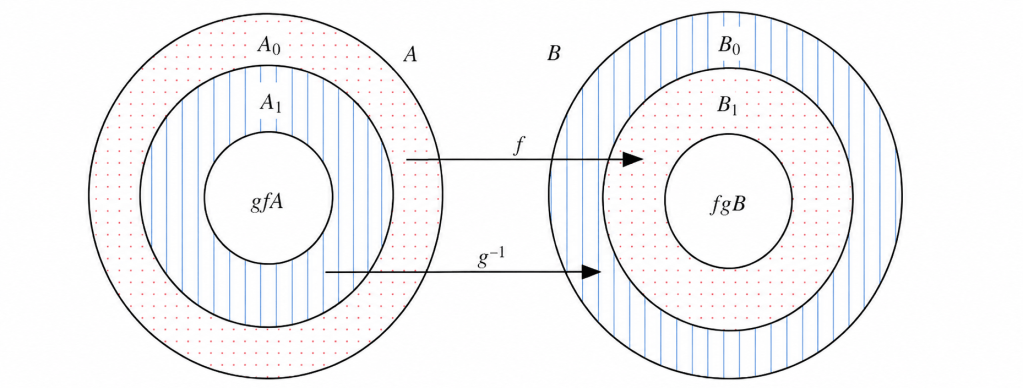
First, separate the disk from , which is the image of under the map . Now, the area inside but outside this disc splits into two regions — the set of points in that do not lie in the image of (call it ) and the points that do lie in the image of but do not lie in (call it ). Do the same for , as shown in the diagram below.
To see why this separation is helpful, look at the image of under . They lie in the image of but outside the disc since is disjoint from the image of . Hence, is a natural bijection from to . Similarly, is a natural bijection from to .
So what the separation is really doing is pairing up two pairs of regions in each of the sets and which are mapped to each other under a bijection, just as we planned.
Moreover, the image of under must clearly lie within the disc and vice versa because the codomain of is , and similarly for the other set. Hence, we can apply the same argument for these smaller discs.
To be precise, we look at instead of and look at instead of . Then, the next two rings in and are,
and
.
As before, maps to and maps to .
Moreover, the rings and are disjoint and we have a bijection defined by
But the issue is that this itself is not enough. To see why, consider the degenerate case where and . Clearly and are non-empty, but none of their elements lie in either of the rings (why?) — they appear to exist in an infinitely deep ‘core’.
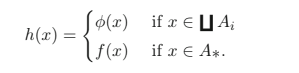
To deal with these elements, let and . Observe that bijects to precisely since these elements do not lie in any of the rings. Hence, we can extend to a bijection defined by









Leave a Reply