Today we shall celebrate Children’s Day (with the painful observation that I no longer qualify as a child) and the two-year anniversary of this blog (time has flown…) by looking at an extremely useful idea which comes up repeatedly in problems involving algorithms or processes.
A state graph of an operation 
One of the most important things to check right away on problems of this sort is whether the edges are directed, i.e whether the operation is reversible. If it is, showing state 

Unless stated otherwise, all distances below are taken in a connected component of an undirected state graph (which shall usually be the case in olympiad contexts). When an operation is reversible, we replace the two opposite directed edges by a single undirected edge.
Before moving on, we need to review several key terms from graph theory. The distance
between two vertices 


We shall informally call a particularly convenient intermediate configuration a home state.1 In graph-theoretic language, we are selecting a vertex through which we can construct short paths between many pairs of states.
A very important result that we shall use time and time again is the relationship between the diameter and radius of a graph.
Theorem 1 (Diameter-Radius)
The radius of a graph is at least half its diameter.
Proof. For the other inequality, choose a vertex 


By the triangle inequality,

Therefore, 
The basic recipe for many problems here is almost repetitive:
Step 1 Pick a suitable state graph and identify the vertex and edge set (usually states and states connected by a single operation). Check whether edges are directed.
Step 2A Determine the home state(s), based on a rough intuition of ‘distance’.
Step 2B Rigorously define distance between states. This parameter will almost always depend on which home state you are looking at, and is usually extreme at the home state, so expect to deal with several definitions concurrently.
Step 3 Bound! Bound! Bound!
Steps 2A and 2B can be performed in either order, but you can always use one of them to motivate the other. This motif will make a lot more sense looking at a contest example.
Problem 2 (IMO Shortlist 2017 C2)
Let 


Swaps are clearly reversible, and the state graph2 is connected since adjacent swaps can ‘sort’ every chameleon.
Here, since we are working with swapping pairs of adjacent letters, we can look at the number of inversions (pairs of letters whose order in the chameleon is opposite to their alphabetical order) of our chameleon.
Each swap switches two adjacent letters, so the number of inversions of chameleon 
Thus, in order to find two chameleons which are far apart from each other, we need to maximize the difference in the number of inversions. This naturally leads us to consider the pair of chameleons 

Clearly, the difference in the number of inversions is 

This framework also appears in some approaches for China 2024/6 and IMO Shortlist 2018 C3.
A common trick involves using a vertex with low eccentricity as a ‘home state’. Hence, an algorithm will involve moving to and from this home state, which cuts down the number of operations required.
One of the shortcomings of this approach is that it requires the state graph of the desired process to be in some sense compact. In fact, in the case where there exist states which are ‘further away’ from the home state, it might be efficient to travel through a different path. To counter this challenge, it is often convenient to define multiple home states and use the path which is closest to the starting/ending state.
We shall look at this generalization in action, with the following two beautiful problems, given at the Iran Team Selection Tests in consecutive years.
Problem 3 (Iran TST 2025/11)
There are 

- Prove that from any configuration where each cup contains an integer amount of water, it is possible to reach a configuration in which each cup contains exactly 1 liter of water in at most
steps.
- Prove that in at most
steps, one can go from any configuration with integer water amounts to any other configuration with the same property.
Let 

Algorithm 1. Pour all the non-empty cups into the 


Observe that the first part takes at most 

Algorithm 2A. Until all the cups contain water, select a cup with at least 2 liters of water, and pour it into the 
Clearly this takes at most 
Now, it is clear that if 


For the second part, our first question is regarding the choice of home state. The most natural option is of course to simply use the one given to us in part (a). We can try using the equidistributed state (or any other single home state), but some playing around with that should convince you that the bounds obtained as such are far too weak.
As before, this is due to the presence of two clearly antipodal states: the equidistributed and extremal (the
Naturally, this introduces the additional parameter 
Algorithm 2B. Pour all the cups with water into the 


The difference is that this does not waste the interim moves which pour water into cups which are supposed to be empty in the final state.
The first part takes at most 


This time, we have three possibilities.
- If we perform algorithm 1 followed by pouring water from any cup which is empty in the final configuration, into any cup which has less water in it than required, then
steps suffice.
- If we perform algorithm 2A followed by pouring water from any cup which is empty in the final configuration, into any cup which has less water in it than required, then
steps suffice.
- If we perform algorithm 2B then
It is not hard to see that at least one of these choices requires at most
Problem 4 (Iran TST 2026/2)
A trick is defined on a 


Again, we scout for our choice of home states. The most natural pair of antipodal states with respect to this operation are the
We can let 

We can let 

It is clear that tricks are reversible.
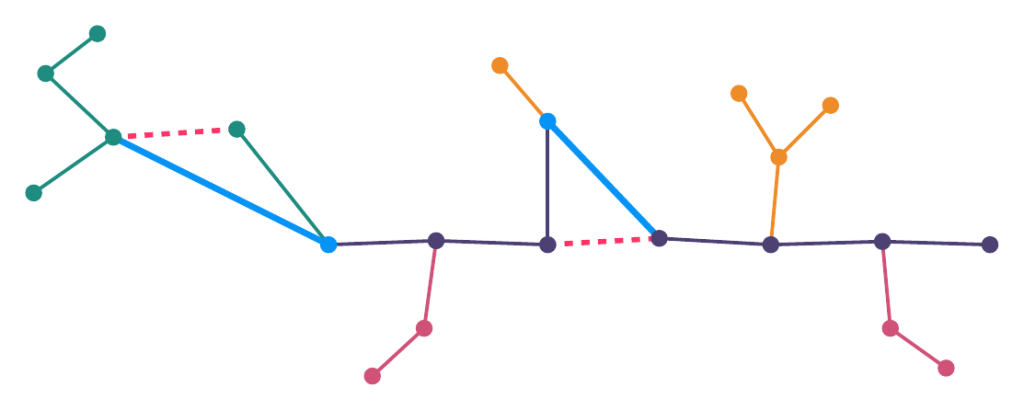
 Right: increasing
 Clearly, any vertex which is a neighbour of a vertex in
By repeatedly applying these two tricks, we can thus transform any tree 

Thus, at most

tricks are required to move between
What remains now is to show that for all sufficiently large 

- This terminology is by no means standard, and you should always explain what you mean by ‘home state’ during an actual contest. ↩︎
- The state graph of such a ‘swapping’ process is commonly referred to as an adjacent-transposition graph. ↩︎
- Hint: think of the tree as rooted. How many generations can we have? How many vertices in each generation? ↩︎


Leave a Reply