Today we shall have a (very brief) look at the 
As usual, a clickable GeoGebra link is attached to the following diagram.
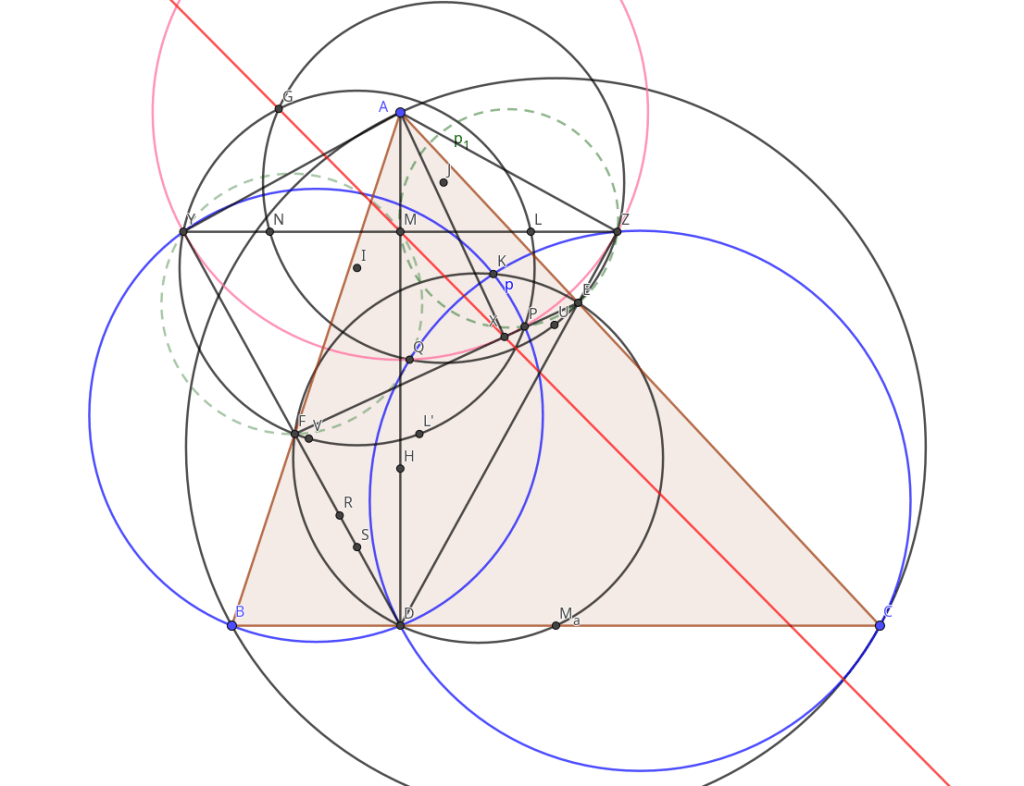
A summary of the key results pertaining to this configuration,
- An easy angle chase shows that
is the incenter of
and that
,
and
are the
and
excenters of the orthic triangle.
- Hence, the feet
,
and
of the perpendiculars from
to the sides
,
and
respectively are the corresponding extouch points of the same triangle.
- Further, one can then observe that the lines
and
are parallel.
- Hence, the feet
- The second intersection
of line
with
and the second intersection
of line
with
both lie on the
- It can then be seen that quadrilaterals
and
are both cyclic. Also, by Reim’s theorem note that the quadrilateral
is cyclic.
- The circles
.
- It can then be seen that quadrilaterals
- The intersection
of line
with line
and the intersection
of
with line
can also be seen to lie on the circle
via angle chase.
- Points
and
respectively. Hence, Power of a Point at
- Further, since quadrilaterals
and
are both cyclic, Reim’s theorem implies that lines
and
are parallel.
- Points
- Quadrilaterals
and
are both cyclic, so it follows that
also lies on the radical axis of circles
as the unit circle.
- Hence, the second intersection points of circles
,
and
are symmetric with respect to point
- Thus, point
to triangle
. Moreover, point
is the center of homothety mapping the triangle
to
- Some angle chasing can then be used to show that points
- It is also true the points
- Hence, the second intersection points of circles


Leave a Reply