This article will explore a relatively new configuration which I have talked about extensively in my handout Neat Config which was crafted from a series of notes made by Om Kutte for lectures conducted by him at the (Unofficial) Indian National Mathematical Olympiad Training Camp.
This is the master diagram. All the point definitions (and most of the key claims) are shown in this picture. However, in the case of an unclear or confusing point simply refer the attached handout.
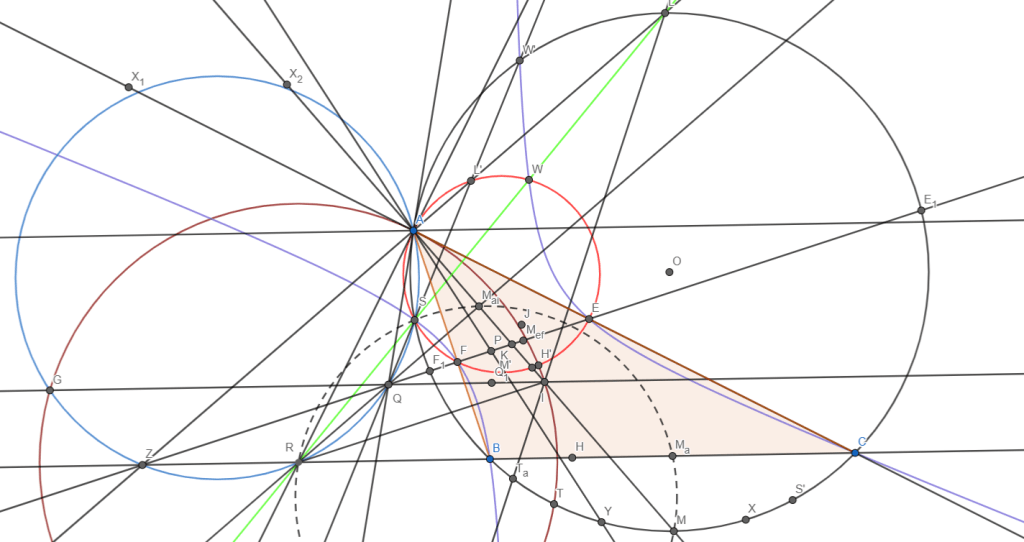
Here is a summary of the key properties that we discovered.
- First, lines
,
and
concur at
(radical center). Further, Miquel properties tell us that
and
are cyclic. Also a straightforward angle chase then shows that
lies on
and the tangent to
at
.
- Next, by Pascal’s Theorem on
the intersection of the tangent to
at
lies on line
. Since
is harmonic (project through I!) it follows that
. This point plays a great vouge in mixtillinear incircle problems. Particularly,
- Lines
are parallel. This is essentially 2006 Russia Regional Grade 11/4 and this parallelism has been explored in mixtillinear contexts in many other sources.
- Point
while points
and
are collinear.
- Line
is the perpendicular bisector of segment
, which implies Brazil Olympic Revenge 2017/2.
- Lines
- Line
and circle
intersect a second time on the line
is the second tangent from
- Lines
and
are parallel. This property generalizes when
is replaced by an arbitrary point inside the triangle and can be easily proven via homothety arguments.
- Using the converse of Pascal’s Theorem on
allows us to show that points
,
,
and
lie on a conic which encapsulates a lot of weird concurrency claims that can be seen. Applying a more general result on quadrilateral circumconics passing through the Miquel Point (by yours truly!) indicates that point
also lies on this conic.
- Now we can apply Pascal’s Theorem on coconic hexagon
to observe that points
- Now we can apply Pascal’s Theorem on coconic hexagon
- Another set of coconic points surface as
turn out to lie on the same conic.
- The intersection of ray
with circle
seems to be the most promising point in this picture. Rushing during the last days of the handout we left this point relatively unexplored.
- Both quadrilaterals
and
are cyclic. Utilizing this a simple angle chase leads to the claim that points
,
and
lie on the same line.
- Also ray
intersects
- Both quadrilaterals
- Line
- Points
,
,
and
lie on the same circle since
and
- Theorem 2.7.2 on i3435’s Muricaaa states that lines
and
- Points
- The angle bisector Miquel point also has connections with the symmedian and median. With some simple angle chasing and a sprinkle of harmonic bundles one can show several claims.
- Since we know that
is harmonic it turns out that ray
hits
.
- Points
and
are concyclic.
- Since we know that
- Points
are collinear. More generally, for any pair of points
on
and
are isogonal, points
- The reflection of
bisector lies on the circle
which is the pith of 2020 Iran TST 2/3 which disguises this result underneath a pile of reflections cleverly.


Leave a Reply