Today we will explore the properties of a certain well-known point with respect to the intouch triangle. The Why Point, originally seen in the famous 2011 G4, is a thoroughly explored configuration with a plethora of interesting properties. Among the many perspectives of the Why Point configuration is the Why Point of the Intouch triangle.
Here is the picture we shall be working with.
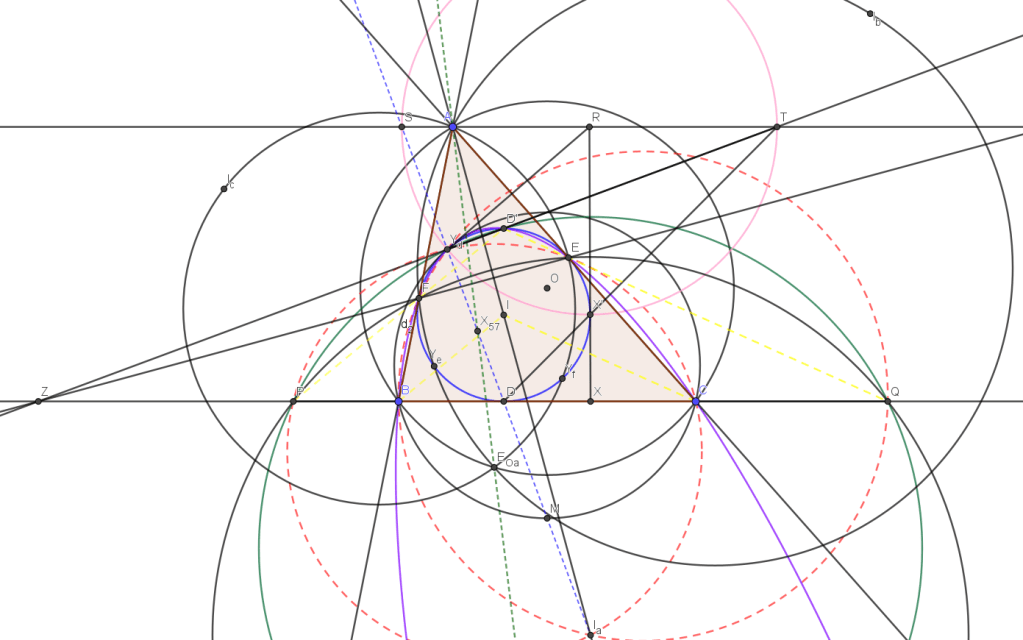
A summary of the key results pertaining to this configuration,
- First, the circles
and
pass through the reflections
and
of
across points
and
respectively.
- Now PoP at
is the radical axis of these two circles.
- Their second intersection
lies on
, which is a straightforward angle chase.
- In particular, a key step is that by Midpoint Theorem the line through the reflection of
(which passes through the
antipode in
, which is the statement of STEMS 2020 B4.
- Now PoP at
- Further, the circles
pass through the
and
Evan is Old Points respectively.
- Most notably, inversion sends this configuration to one involving the mixtillinear excircles which are mostly easier to handle.
- An easy angle chase shows that
is cyclic from which Radical Center Theorem on circles
and
we have that lines
and
intersect on
.
- The converse of Pascal now implies that points
,
and
- Shooting Lemma now yields the most famous Shortlist 2002 G7 which tells us that circle
is tangent to
at
- The pairwise radical axes of circles
and
concur at
, the homothety center of the intouch and excentral triangles which is essentially RMM 2012/6.
- The pairwise radical axes of circles
- To see why the point
defined as the tangency point of
(the circle through
,
- Inversion about the incircle maps
to
where
and
are the midpoints of segments
and
, whose tangency point to the circumcircle is the Why Point as per Shortlist 2011 G4.
- Now, a homography mapping the centroid of the intouch triangle to it’s circumcenter while preserving the incircle tells us that lines
,
and
are also concurrent.
- Furthermore, if
is the reflection of
and similarly, lines
and
concur at the centroid of
- Inversion about the incircle maps
- Now, revisiting Fake USAMO 2020/3 we have that lines
,
and
also concur at this homothety center
- Throwing in
to the picture, which we know is the symmedian point of
,
- Also of interest is the tangent to
shows that the second tangent to
and the tangent to
parallel to line


Leave a Reply