In this article we provide investigate a famous classical process involving piles of stones (or originally cards) introduced by Martin Gardner.
The game involves a set of piles of stones with 


Despite the overwhelming amount of work on this topic, it was almost impossible to find a clear and intuitive solution which appreciates the beauty of this process. The following solution is due to Tony Wang.
1. Setting up an attack
In order to attack the problem, we first need to come up with some representation or setup which allows us to record the variation in the distribution of piles.
The most natural way to do this is to represent each stone as a dot, and let dots be in the same column if they are in the same pile. Now, we have a choice to make on how we represent the movement of stones. For example, we can always place the new pile in the rightmost position.
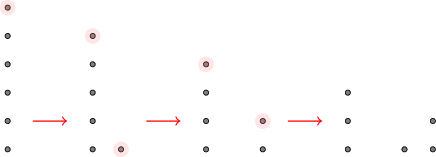
In each case, the highlighted stones are those which are picked to form a new pile.
However, one realizes it is extremely difficult to understand how the piles that using this representation, partly since the piles which ‘disappear’ leave empty columns. Always rearranging the piles so that they are in decreasing order of size is even more obscure since the position of each new pile is already hard to control.
To fix this issue we utilize the following process to go from one position to the next.
Algorithm : Let 


It is clear that this corresponds to the given operation since the bottom-most stone in each column ends up in the leftmost new column. However, one might notice that this leads to situations when there are columns with spaces in between stones. Since this is awkward, we imagine the stones to be in a world where gravity exists and the stones fall down. So, a stone will occupy the lowest position available in it’s column.
Repeating the previous example using this algorithm,

Using this representation, we show the stronger claim that not only will the piles eventually be of sizes 


2. ‘Inventing’ information to track
Increasing the amount of information available for tracking is an incredibly powerful tool since it allows us to treat the system more ‘rigidly’. In this case, allowing the stones to be indistinguishable leaves a lot of ambiguity about which stone goes where, so to increase the rigidity of the system we treat each stone independently.
The trick is now to look at the trajectories of each individual stone, and the reason why the above representation is so powerful is simply because it allows us to achieve this goal beautifully.
For example, the stone at 

To make things more clear, we shall repeat the previous example, this time highlighting each distinct stone in a different color.

Let a diagonal be a line parallel to the line 
- Each stone cycles within the diagonal it lies in, so its ‘diagonal number’ is non-increasing.
- Furthermore, if a stone lands in a position which has no stone underneath it, by gravity it falls down to a smaller diagonal.
We shall now work out the finer details of these two heuristics.
3. Fine tuning and Proofs
If a stone is not at the bottom row, it simply moves by the vector 

Now, in order to finish, we simply need to show that it is impossible for some stone to never fall down if it has to.
Consider the smallest isosceles right triangle with a vertex at 

Clearly at least one of these stones (say 

However, since 

Hence, any holes must be filled in a finite number of steps and indeed we are left with the perfect triangle configuration, as desired.


Leave a Reply