In this article, we shall explore some properties of the intersections two highly celebrated circles in the world of Olympiad geometry. Although the individual circles are thoroughly explored and considered mostly ‘well-known’, the configuration involving their intersections is still relatively unexplored, with only two notable examples appearing on an Olympiad to date, as far as I am aware.
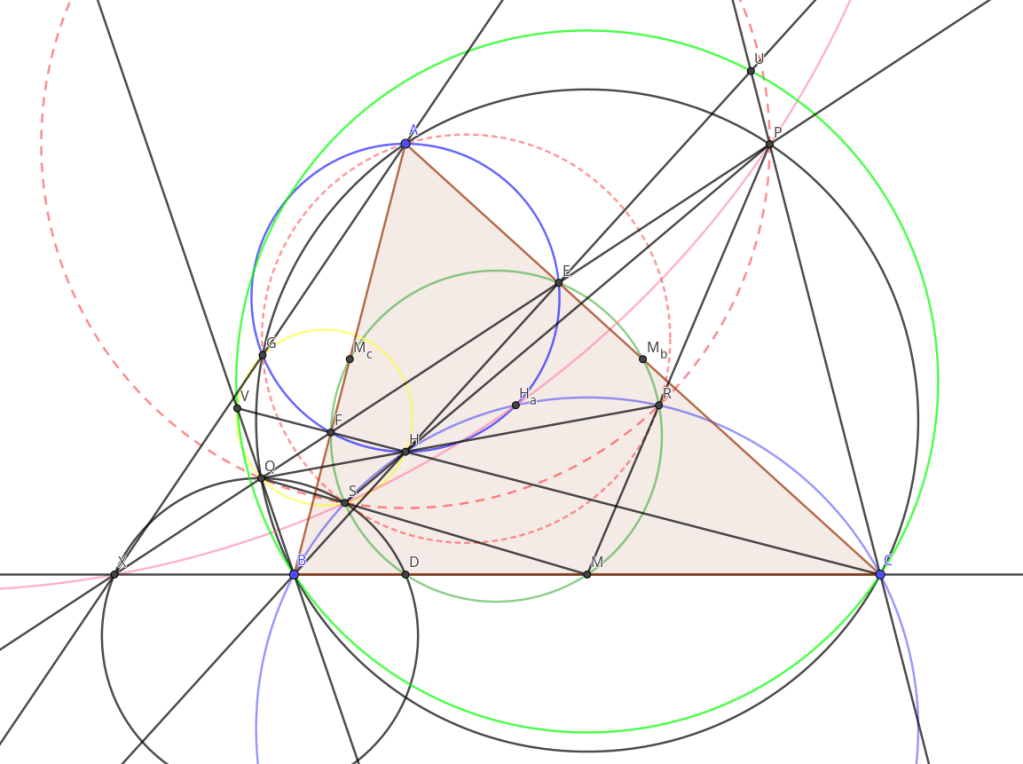
We shall follow the notation given in the above diagram, with most points carrying their traditional labels.
A summary of the key results pertaining to this configuration,
- First, we can consider the inversion centered at
with radius
followed by a reflection across point
with
and
with
. Hence,
and
as well as
and
are inverses of each other.
- This immediately implies that points
and
and
- Further, this yields
which indicates that
, and similarly
is cyclic.
- Since it is well known that
is cyclic, this also implies that
passes through
.
- This immediately implies that points
- Next, look at the inversion centered at
with radius
. This swaps
and
- Hence,
so quadrilateral
is cyclic with center
- Moreover, since
, the quadrilateral
is a kite and is thus harmonic. Projecting through
which is sufficient to conclude that the polar of
with respect to
and
which solves this problem by Kudo3105.
- Hence,
- Finally, look at the inversion centered at
with radius
. This swaps
). Hence, this swaps points
- We now have that points
and
and
- From our first observation that points
and similarly quadrilateral
are cyclic.
- Further, we have
so quadrilaterals
and
are both cyclic.
- Similarly,
which implies that quadrilaterals
and
are both cyclic.
- Finally,
which implies that quadrilaterals
and
are also both cyclic.
- Also worth noting is that by Brokard’s Theorem on cyclic quadrilateral
we have that
is self polar with respect to
.
- We now have that points
- Using both the above main results we can then show with a little angle chasing that quadrilaterals
and
are cyclic.
- Considering the aforementioned inversion at
and
are cyclic.
- Considering the aforementioned inversion at
- By Radical Center Theorem on circles
and
concur at
- A straightforward angle chase now allows us to show that
lies on
and similarly
lies on
, which solves 2024 German MO Problem 3.
- From our previous observation that
it follows that
and hence
. An alternate proof is to apply Pascal’s Theorem on concyclic hexagon
.
- Furthermore, by Reim’s Theorem it hence follows that quadrilateral
is cyclic.
- From our previous observation that
- Using harmonics it is not hard to see that
lies on the line through
and
.
- This then allows us to show that
is the internal
bisector proving 2025 Brazil MO Problem 5.
- This then allows us to show that


Leave a Reply