Today we shall have a look at a simple configuration which is moderately prevalent in modern Olympiads but has not received much attention. Our work shall involve the feet of the perpendiculars from the foot of the 


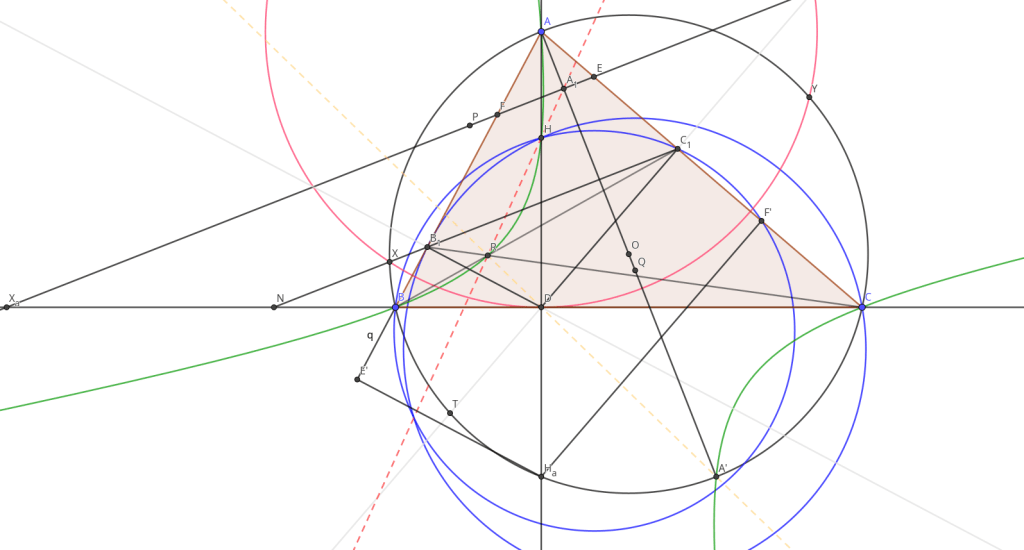
As usual, notation is borrowed from the diagram attached above, with most familiar points carrying their standard labels.
A summary of key results pertaining to this configuration,
- First, an easy angle chase yields
cyclic. Hence, by Reim’s it also follows that
. Moreover, this means
as well. Also, it is clear that
is cyclic due to the right angles.
- Let
and
be the feet of the altitudes from
and
to line
respectively. Clearly,
and
are both cyclic.
- Since
is the incenter of
, it then follows that
. Similarly,
which implies that
.
- As noted before,
so it follows that
.
- Further, the reflection of
must lie on the line through
. Thus,
.
- Since
- Next, consider the inversion centered at
. This swaps
and
with
. Hence,
and
as well as
- This implies that
and thus
. Moreover, since
this circle is tangent to
at
- By the Incenter/Excenter lemma, we then have that
which proves 2023 Azerbaijan JBMO TST Problem 3.
- This implies that
- Note that since
with respect to
lies on the perpendicular bisector of
- It is not hard to see that the isogonal conjugate of the
with respect to
. Hence,
of
- Pascal’s Theorem on conconic hexagon
then implies that
lies on the line through
perpendicular to
and
- It is not hard to see that the isogonal conjugate of the
- Since
is cyclic it is also clear that points
and
are equidistant from
- Thus
is the perpendicular bisector of segment
which implies that quadrilateral
is a kite, and hence harmonic.
- Thus
- Applying Pascal’s Theorem once more on conconic points
implies that
lies on the line through
and
- Hence, projecting
through
and a further projection through
and
are collinear.
- This immediately shows that points
and
- Hence, projecting
- Furthermore, the feet of the altitudes from
to the sides
and
must be the reflections of
and
across
and
- Hence by the Mean Geometry theorem it follows that
as well, so by Reim’s theorem
must also be cyclic.
- Furthermore, since the line through
it follows that the orthocenter of
is the intersection of lines
and the line through
- Returning to a previous claim, this implies that
lies on
it follows that
lies on the line through
- Combining this with the previous observation, this implies that
is parallel to
- Hence by the Mean Geometry theorem it follows that


Leave a Reply