Today we shall look at a rather interesting configuration which has appeared in only a handful of problems to date with rather surprising and occasionally obscure results. Our work shall explore the tangents from the point 


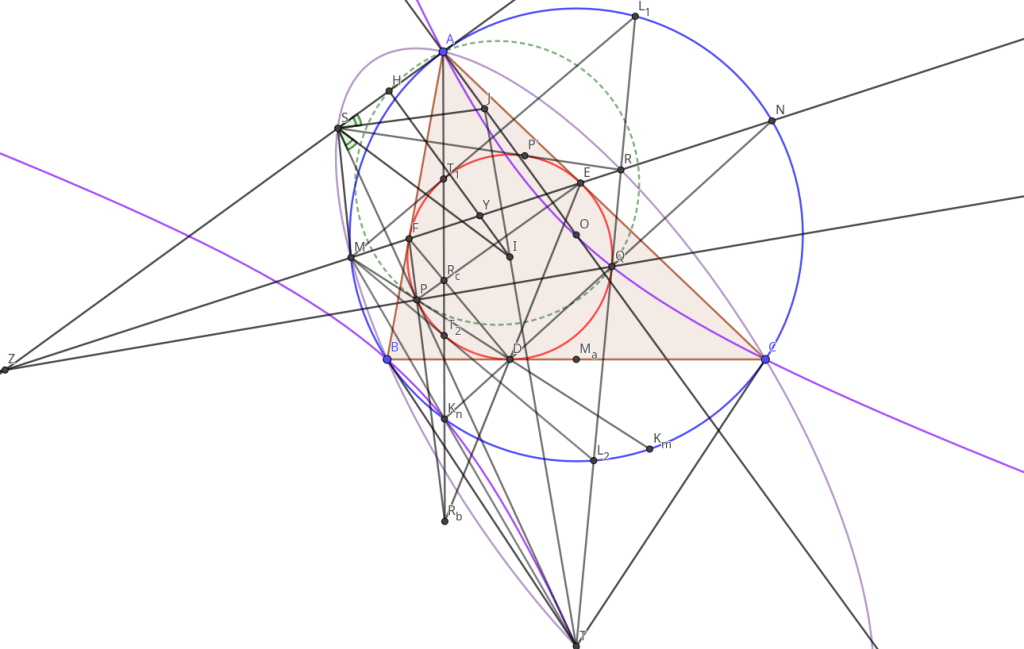
As usual, notation is borrowed from the diagram attached above, with most familiar points carrying their standard labels. In case of an unclear definition, the above diagram is linked to a GeoGebra file which can be referred.
A summary of key results pertaining to this configuration,
- First, the points
and
are the tangency points from
to the incircle
.
- Pascal’s Theorem on concyclic hexagons
and
show that points
,
and
all lie on the same line.
- Pascal’s Theorem on concyclic hexagons
and
show that points
,
and
are collinear. Thus, the line through
and
- Finally, Pascal’s Theorem on concyclic hexagons
and
implies that points
and
are collinear.
- Combining all these applications we conclude that the tangent to
.
- Pascal’s Theorem on concyclic hexagons
- Let
and
be the tangents from
with respect to
.
- Projecting from
is harmonic, so points
and
- Further, since
is the harmonic conjugate of
with respect to segment
a projection at
implies that
.
- Projecting from
- Pascal’s Theorem on concyclic hexagon
yields that
lies on
.
- By Brokard’s Theorem on cyclic quadrilateral
it follows that
lies on the polar of
and
- This implies that
and projecting through
is harmonic.
- In particular, we have that
and
are the polars of
- By Brokard’s Theorem on cyclic quadrilateral
- By Poncelet’s Porism it follows that
is tangent to
and
lie on the tangent from
- Since
, projecting through
lies on the polar of
– the intersection of the tangent to
at
, with respect to the incircle.
- Since
tangent to
and
concur at
- Thus,
also lies on the polar of
, the second tangency point from
.
- Hence, projecting through
is harmonic which also implies that points
are collinear. This immediately also implies that lines
and
which solves 2025 December MEOW Problem 6.
- Since
- Applying Pascal’s Theorem yet again on concyclic hexagon
and
implies that points
,
and
are collinear and thus points
and
- A further application of Pascal’s Theorem shows that
also lie on this conic.
- Further, sets of points
and
are also conconic which is easy to confirm via Pascal’s Theorem.
- A further application of Pascal’s Theorem shows that
- Let
denote the foot of the altitude from
to the
is the polar of
- Hence,
which implies that quadrilateral
is cyclic. Further,
which implies that quadrilateral
is also cyclic.
- Since the pedal circles of isogonal conjugates are well known to coincide, this implies that
is the isogonal conjugate of
since
is clearly the internal
bisector. This wraps up 2024 Vietnam TST Problem 5.
- Incidentally, this also implies that
to
.
- Hence,


Leave a Reply