Today we shall look at something different from usual, and turn our attention to a famous triangle center, named after Benjamin Bevan — the circumcenter of the excentral triangle or the Bevan point 

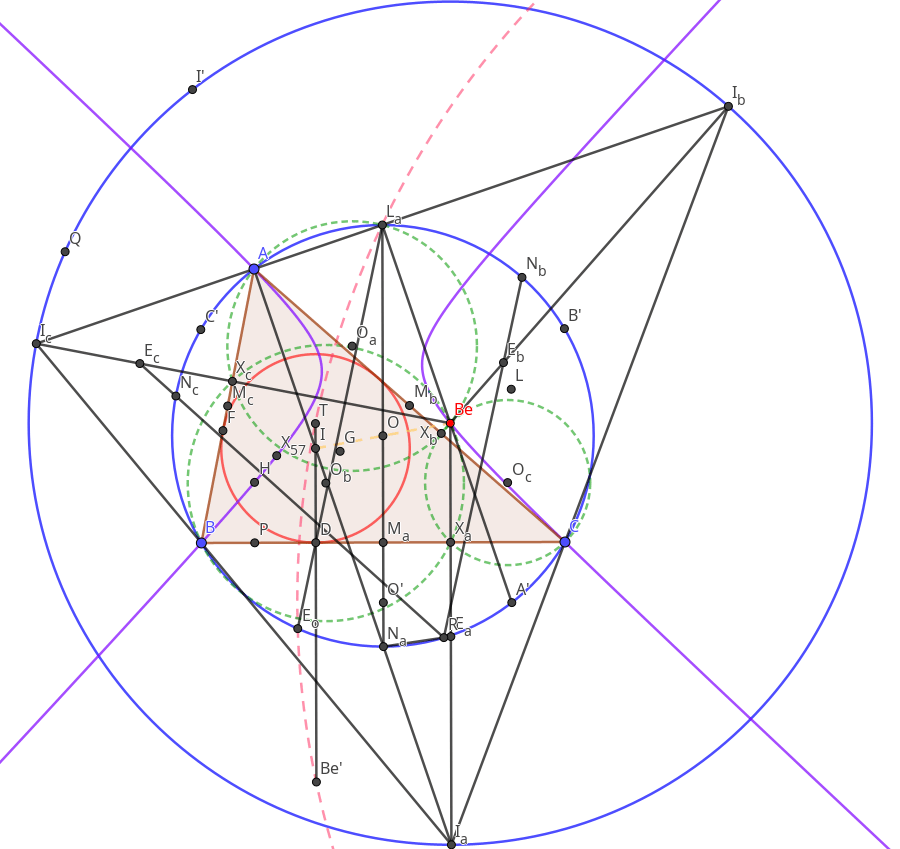
Notation will comply with the point definitions in the above diagram, to which a clickable GeoGebra link is attached.
A summary of the key results pertaining to this configuration,
- First observe that since
and
are the orthocenter and nine-point center of the excentral triangle respectively it is well known that the Bevan point
across its circumcenter.
- Returning to the definition, since in intouch and excentral triangles are homothetic, it follows that their center of homothety lies on the line
which solves 2003 Vietnam TST Problem 2.
- Also, quadrilateral
has diagonals which bisect each other, implying that it is a parallelogram. Since
is the midpoint of segment
we also have that quadrilateral
is a parallelogram.
- Due to this reflection, it follows that
where
is the
Sharkydevil point of
- Since it is well known that the circumcenter and orthocenter are isogonal conjugates,
and similarly. Shifting our reference triangle from the excentral triangle to
we immediately have 2015 Macedonia MO Problem 1.
- Finally, if
are the minor arc midpoints in
, by the Incenter-Excenter lemma we know that
of
lies on
and similarly, which disposes of this problem by betongblander.
- Returning to the definition, since in intouch and excentral triangles are homothetic, it follows that their center of homothety lies on the line
- Denote by
and
the
and
antipodes in
it follows that
so by the Mean Geometry theorem the midpoint of segment
lies on the perpendicular bisector of segment
.
- A homothety centered at
proving the collinearity of these lines.
- Further, quadrilaterals
and similarly are cyclic due to the right angles so their centers
are the midpoints of segments
and similarly. The previous observation then implies that the lines through
parallel to the internal
bisector and similarly all pass through the circumcenter
- Since
is a rectangle and
is equidistant to
and
it follows that
arc midpoint which contains
. Hence,
is the internal
bisector which in conjunction with the previous observation implies that
.
- Moreover, a homothety centered at
with scale factor 2 maps the medial triangle to the antipodal triangle and hence the Spieker center
to the Bevan point
, which has appeared in a contest from Bulgaria in 2004.
- Further, a straightforward angle chase shows that quadrilaterals
and similarly are all concyclic.
- A homothety centered at
- Since the diagonals of quadrilateral
bisect each other at
is the de Longchamps point of
, it follows that
is also a parallelogram. So, points
and
- It is well known that points
and
all lie on the Nagel line of
and
(homothety centered at the centroid
mapping the reference triangle to the medial triangle) so
. Projecting through
.
- It is well known that points
- Returning to the reflections of
and
, observe that
passes through
. A homothety centered at
.
- A homothety at
followed by a homothety at
to
which is well known to be similar to
. Hence it is clear that
.
- Thus,
to
and hence also the center of spiral similarity mapping segment
to
. Spiral similarity properties imply that
lies on
and
concur on
- With a bit more work, one can also show that this concurrence point is the orthopole of
with respect to the excentral triangle.
- A homothety at
- Let
and
denote the intersections of
with
such that
is the reflection of
across the midpoint of segment
is an isosceles trapezoid. In particular, this implies that
antipode in
- Hence, a homothety centered at
to the perpendicular bisector of segment
, so it follows that quadrilateral
is an isosceles trapezoid.
- It is well known that points
and
are collinear where
is concyclic by Power of a point at
- Now, an easy angle chase shows that points
and
lies on the Evan is Old cevians,
- Hence, a homothety centered at
- Note that
where
is the foot of the
by the radical center theorem.
- It is not hard to see due to isogonality and rtbc inversion that
. Then an easy angle chase shows that points
and
are collinear.
- A further angle chase utilizing this similarity shows that
is cyclic, which implies that
also lies on the circle established in the second bullet point, which is a central claim to both 2018 ELMO Shortlist G5 and 2024 IGO Advanced Problem 3.
- It is not hard to see due to isogonality and rtbc inversion that
- Several applications of the Pythagorean theorem show that the Bevan point satisfies the length condition
, which appears in 2003 IMO Shortlist G3 which claims that the Bevan point is the unique point which satisfies this condition with respect to it’s pedal triangle.
- The Darboux cubic is known to pass through the points
 -altitude
 , the de Longchamps point
.
- By Cayley-Bacharach on
,
and
, it follows that points
are coconic.
- By Pascal’s theorem on the coconic hexagon
it follows that points
,
and the intersection of the reflection of
across the midpoint of
are all collinear, solving this interesting problem from Twitch Solves ISL by DottedCaculator.
- By Cayley-Bacharach on


Leave a Reply