Today we shall have a look at a generalized configuration, with certain noteworthy special cases. Problems from this configuration seem to not yet have appeared in olympiads, with the only problem I am aware of being due to Ethan Wang. Also, shoutouts to Yanqing Yang for several key ideas and claims.
Since most points are unfamiliar, we shall first take a moment to define all points used in the above diagram (the following title is a drop-down list).
Definitions
Let 


Let 

Let 


Let 


Let 


Let 


Let 


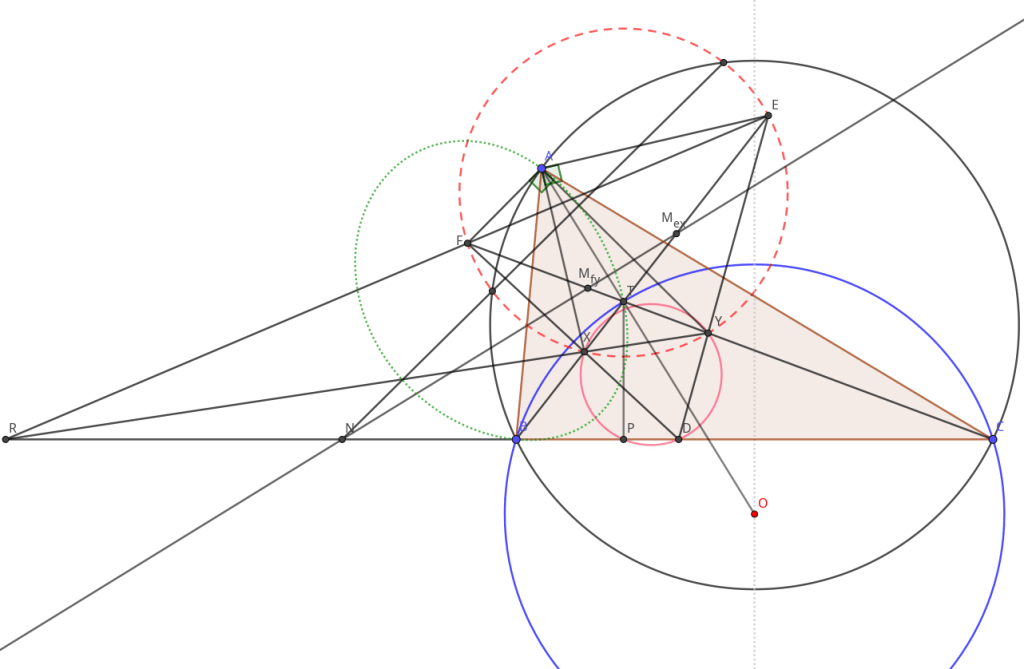
We shall follow the point definitions in the above diagram, to which a clickable GeoGebra link is attached.
A summary of the key results pertaining to this configuration,
- First, an easy lengths calculation (for example Menelaus’s theorem) shows that lines
,
and
concur. From the Ceva/Menelaus picture it then follows that
. This also implies that
.
- Projecting through
and
respectively.
- Now, applying Prism lemma we have that lines
concur at
- Now, applying Prism lemma we have that lines
- An easy angle chase shows that lines
and
are isogonal with respect to
.
- Then, Desargues Dual Involution theorem at
on quadrilateral
implies that the pairs
and
form an involution. The former two imply that this involution is reflection across the internal
bisector, so it follows that
and
are isogonal with respect to
- An alternate proof of this isogonality is to note that since
is the internal
bisector, we must have
and similarly,
.
- Then, Desargues Dual Involution theorem at
- Note that since
is orthogonal to
is orthogonal to
- As a result, inversion about
and
fixed, implying that their radical axis contains
- Moreover, we know from the previous bullet point that
is the radical axis of circles
- Since
and thus
must be cyclic. In particular, this means that
.
- As a result, inversion about
- With the claim that
.
- For example, this means that
and
must both lie on the line
- Further, the Miquel point of quadrilateral
,
,
and
.
- Also, it is well known that
, so
and
.
- For example, this means that
- The special cases when
coincides with the midpoint of segment


Leave a Reply