Today we shall have a look at another orthocentric configuration, that of the Miquel point of the quadrilateral formed by the intersections of the tangent to circle 


As usual, points follow their standard labels (except for the renaming of the 

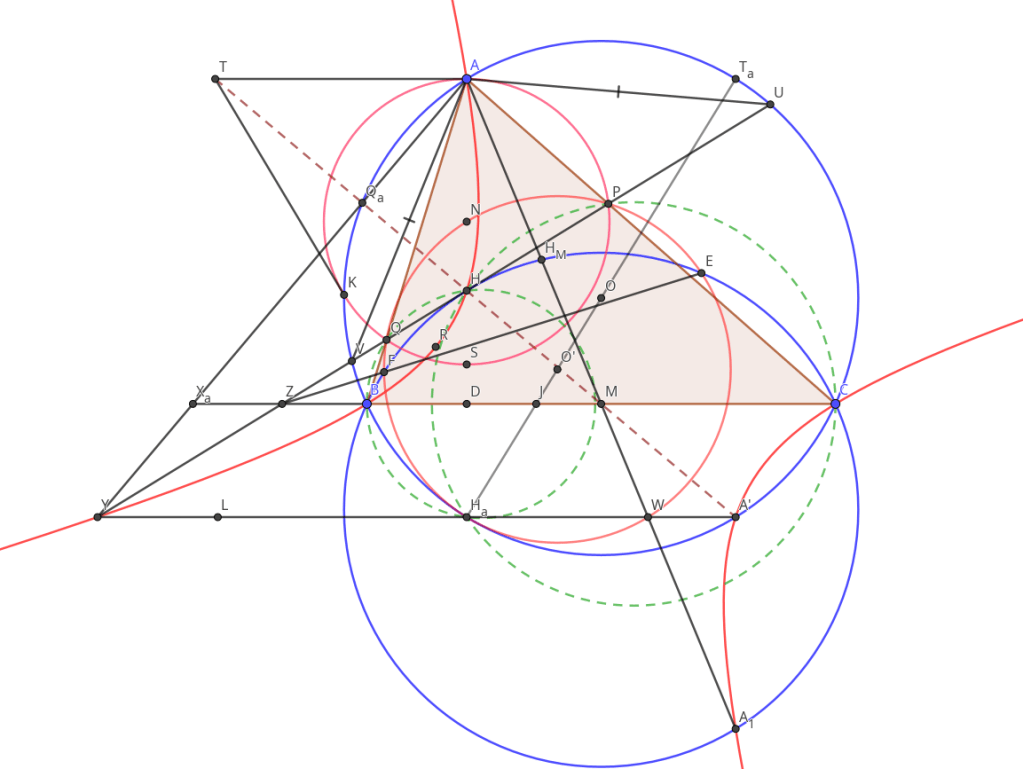
A summary of the key results pertaining to this configuration,
- First, an easy angle chase shows that quadrilateral
is cyclic. Hence, by Radical center theorem on circles
,
and
it follows that lines
,
and
concur at
.
- Since it is well known that the
diameter of
.
- Since it is well known that the
- Reflection across the line
implies that
is tangent to
and since it is well known that
we have that
with respect to
- In particular, this implies that quadrilateral
is also harmonic and hence projecting onto line
we have that the
across
- In particular, this implies that quadrilateral
- It is not hard to see that the Miquel point of
with respect to
and
are also cyclic.
- Since
lies on the rectangular circumhyperbola of
. Pascal’s theorem on coconic hexagon
implies that lines
and
concur, which since the latter two are both perpendicular to side
implies that
and hence points
and
- It is not hard to see that point
must also lie on this line due to the right angles. Further, if
then
is also cyclic by PoP at
also lies on this line due to the right angles.
- Since
- Quadrilaterals
and
are also cyclic which by an easy angle chase shows that the midpoint
of segment
lies on
.
- Further, we can also show that line
- Further, we can also show that line
- Now, consider the inversion centered at
. This inversion swaps the pairs
,
.
and
due to the cyclic quadrilaterals noted above.
- Thus, this inversion swaps line
with circle
which solves the following easy problem on AoPS.
- Also, this inversion swaps circles
. Combining this with the previous result it follows that quadrilateral
is cyclic with center
passes through
- Since
is well known to be cyclic, it follows that
is too by Reim’s theorem. Thus, this inversion swaps points
. In particular, this implies that
- As we noted before that
. Thus,
which is the line through
implying that
must map to the
- Thus, this inversion swaps line
- Note that
and
are tangent to
lies on
we have
implying that
is the polar of
- But then
lies on the polars of both
and
is the polar of
with respect to this circle.
- It is not hard to check that
so it follows that lines
and
are parallel. In particular, this means that
which must imply that
is the polar of
bisects segment
- But then
- Let
denote the rectangular circumhyperbola of
also lies on this hyperbola.
- It is easy to show via lengths that the line through
and
is parallel to
,
and
are collinear which by the converse of Pascal’s theorem implies that
- It is also not hard to see that points
and
are collinear implying that the points
,
,
,
and
are coconic.
- It is easy to show via lengths that the line through
- Since
by reflection, it is clear that lines
and
intersect on
are collinear. By reflection across the line
- The inversion we mentioned before shows that
is cyclic, on which
is a kite due to symmetry.
- By PoP at
is cyclic. Further, the above observation implies that
- Also by Reim’s it further follows that
is cyclic, which implies that lines
,
concur.
- The inversion we mentioned before shows that


Leave a Reply