This blog post corresponds to my newest olympiad handout on discrete continuity.
The concept of discrete continuity is an extremely effective and versatile method in tackling a wide variety of combinatorics problems. This technique has been used extensively for many years especially in particular classes of problems. Here, after a quick recap of the basics we shall look at the solutions to some of the more interesting problems from the Practice Problems section of the handout.
The idea behind the notion of discrete continuity is that if an integer valued function changes by at most one at each step it must be surjective within its range.
A common style of problems which falls prey to this technique are number theory problems which ask you to show there exists a string of 


The recipe for these problems is quite simple – show there exists strings of
Here is Serbia 2014 Problem 4.
A natural number
is said to be crazy if and only if there exists positive integers
for which
. Show that there exists a set of 2014 consecutive natural numbers of which exactly 2012 are crazy.
We look at the function 

Let a number be called sane if it is not crazy. Note that since 1,2,3,4,5 are all sane due to size restrictions, 


Now comes the punchline – since 


Part of the reason why this method is so effective is that it is an existential technique. It guarantees the existence of objects satisfying the criteria you need without explicitly mentioning what they are. For example, in the above problem we don’t even have any idea about the size of the set of 2014 consecutive integers which work (except that it lies between the two extremes – 1 and 
Next, we shall look at an interesting problem which appeared on the 2004 Putnam.
Basketball star Yang Liu’s team statistician keeps track of the number,
, of successful free throws he has made in his first
attempts of the season. Early in the season,
The key idea is to define the function 
Before we proceed, a natural question to ask is – ‘why this function?’. The answer is simple. It is zero precisely when
Our hope is that 

Clearly, 
An interesting thing to note is that this solution only worked since 

To finish things off we play with some windmills on Brazil 2018 Problem 6.
Consider a set
points in the plane, no three collinear, and the
triangles with vertices in
of these triangles.
What I like most about this problem is that at a glance discrete continuity is an idea that you would never come up with – even if you had 14 bottles of 34% w/w hydrochloric acid to drink last night. Global approaches like pigeonhole seem more promising.
However, experimenting with small cases we make an interesting observation – the ‘center’ of the distribution of points always seems to work. That is, if we consider two lines which divide the plane into four regions such that there are exactly
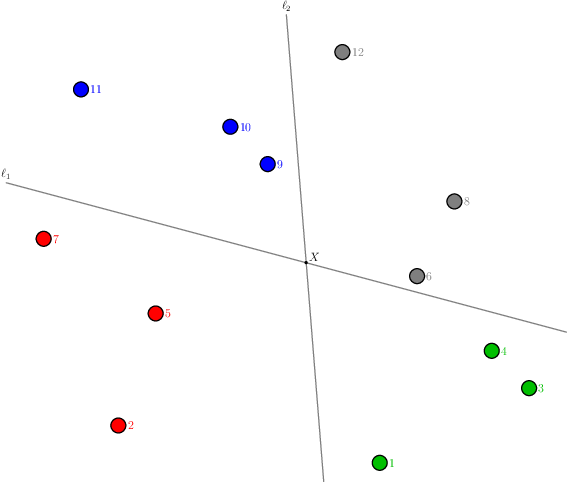
The idea is that if we pick one point from each quadrant, the resulting quadrilateral has at least two triangles pick cover

triangles which cover the point
With this observation in hand, we have suddenly turned the tides – this is simply a stronger version of Example 11 in the handout!
We first show that for any line 


We begin with 

We can also tweak this argument to divide the plane into four quadrants. Simply fix a line
At any moment, 


Leave a Reply