Today we shall celebrate Children’s Day (with the painful observation that I no longer qualify as a child) and the two-year anniversary of this blog (time has flown…) by looking at an extremely useful idea which comes up repeatedly in problems involving algorithms or processes.
A state graph of an operation 
One of the most important things to check right away on problems of this sort is whether the edges are directed, i.e whether the operation is reversible. If it is, showing state 

Unless stated otherwise, all distances below are taken in a connected component of an undirected state graph (which shall usually be the case in olympiad contexts). When an operation is reversible, we replace the two opposite directed edges by a single undirected edge.
Before moving on, we need to review several key terms from graph theory. The distance
between two vertices 


We shall informally call a particularly convenient intermediate configuration a home state.1 In graph-theoretic language, we are selecting a vertex through which we can construct short paths between many pairs of states.
A very important result that we shall use time and time again is the relationship between the diameter and radius of a graph.
Theorem 1 (Diameter-Radius)
The radius of a graph is at least half its diameter.
Proof. For the other inequality, choose a vertex 


By the triangle inequality,

Therefore, 
The basic recipe for many problems here is almost repetitive:
Step 1 Pick a suitable state graph and identify the vertex and edge set (usually states and states connected by a single operation). Check whether edges are directed.
Step 2A Determine the home state(s), based on a rough intuition of ‘distance’.
Step 2B Rigorously define distance between states. This parameter will almost always depend on which home state you are looking at, and is usually extreme at the home state, so expect to deal with several definitions concurrently.
Step 3 Bound! Bound! Bound!
Steps 2A and 2B can be performed in either order, but you can always use one of them to motivate the other. This motif will make a lot more sense looking at a contest example.
Problem 2 (IMO Shortlist 2017 C2)
Let 


Swaps are clearly reversible, and the state graph2 is connected since adjacent swaps can ‘sort’ every chameleon.
Here, since we are working with swapping pairs of adjacent letters, we can look at the number of inversions (pairs of letters whose order in the chameleon is opposite to their alphabetical order) of our chameleon.
Each swap switches two adjacent letters, so the number of inversions of chameleon 
Thus, in order to find two chameleons which are far apart from each other, we need to maximize the difference in the number of inversions. This naturally leads us to consider the pair of chameleons 

Clearly, the difference in the number of inversions is 

This framework also appears in some approaches for China 2024/6 and IMO Shortlist 2018 C3.
A common trick involves using a vertex with low eccentricity as a ‘home state’. Hence, an algorithm will involve moving to and from this home state, which cuts down the number of operations required.
One of the shortcomings of this approach is that it requires the state graph of the desired process to be in some sense compact. In fact, in the case where there exist states which are ‘further away’ from the home state, it might be efficient to travel through a different path. To counter this challenge, it is often convenient to define multiple home states and use the path which is closest to the starting/ending state.
We shall look at this generalization in action, with the following two beautiful problems, given at the Iran Team Selection Tests in consecutive years.
Problem 3 (Iran TST 2025/11)
There are 

- Prove that from any configuration where each cup contains an integer amount of water, it is possible to reach a configuration in which each cup contains exactly 1 liter of water in at most
steps.
- Prove that in at most
steps, one can go from any configuration with integer water amounts to any other configuration with the same property.
Let 

Algorithm 1. Pour all the non-empty cups into the 


Observe that the first part takes at most 

Algorithm 2A. Until all the cups contain water, select a cup with at least 2 liters of water, and pour it into the 
Clearly this takes at most 
Now, it is clear that if 


For the second part, our first question is regarding the choice of home state. The most natural option is of course to simply use the one given to us in part (a). We can try using the equidistributed state (or any other single home state), but some playing around with that should convince you that the bounds obtained as such are far too weak.
As before, this is due to the presence of two clearly antipodal states: the equidistributed and extremal (the
Naturally, this introduces the additional parameter 
Algorithm 2B. Pour all the cups with water into the 


The difference is that this does not waste the interim moves which pour water into cups which are supposed to be empty in the final state.
The first part takes at most 


This time, we have three possibilities.
- If we perform algorithm 1 followed by pouring water from any cup which is empty in the final configuration, into any cup which has less water in it than required, then
steps suffice.
- If we perform algorithm 2A followed by pouring water from any cup which is empty in the final configuration, into any cup which has less water in it than required, then
steps suffice.
- If we perform algorithm 2B then
It is not hard to see that at least one of these choices requires at most
Problem 4 (Iran TST 2026/2)
A trick is defined on a 


Again, we scout for our choice of home states. The most natural pair of antipodal states with respect to this operation are the
We can let 

We can let 

It is clear that tricks are reversible.
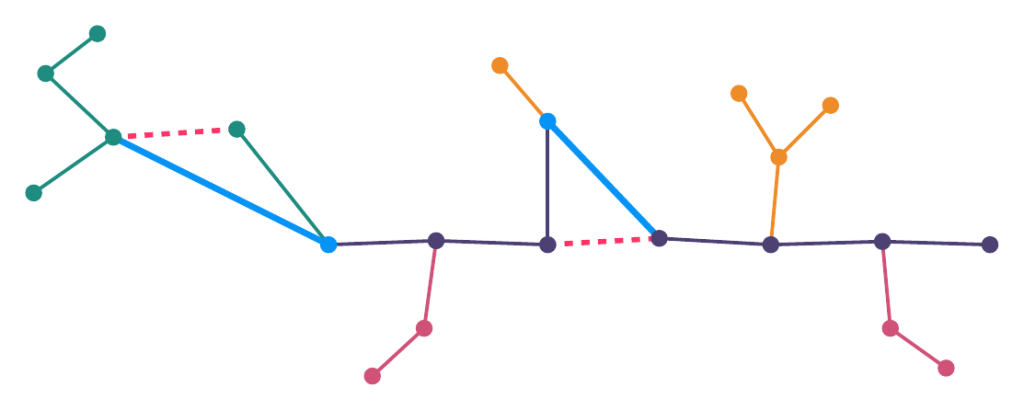
 Right: increasing
 Clearly, any vertex which is a neighbour of a vertex in
By repeatedly applying these two tricks, we can thus transform any tree 

Thus, at most

tricks are required to move between
What remains now is to show that for all sufficiently large 

- This terminology is by no means standard, and you should always explain what you mean by ‘home state’ during an actual contest. ↩︎
- The state graph of such a ‘swapping’ process is commonly referred to as an adjacent-transposition graph. ↩︎
- Hint: think of the tree as rooted. How many generations can we have? How many vertices in each generation? ↩︎
 in the three-dimensional Euclidean space.
 , is the perpendicular-bisector plane of
  ,
,  and
and  have a unique common point
  , which is equidistant to each of the vertices. This, is the circumcenter of tetrahedron
 ,
,  ,
,  , settling the claim.
  denote the perpendicular-bisector plane of side
  of
of  . This plane must be parallel to
  of the tetrahedron.
 .
. . Since
  , line
  is perpendicular to side
  is perpendicular to side
  so it is also perpendicular to side
  .
. .
. .
. is the foot of the altitude from
  . Then,
  (confirm why!). Repeating the argument for the two other sides implies that
  .
. . Since
  and
and  , it follows that
  . The other vertices work identically, implying that
  intersects the plane
  at
at  and the circumsphere of
  . Prove that
  .
.  hit
hit  again at
  hit
hit  again at
  respectively.
 of
of 
 .
. hit the circumcircle of
  again at
  (why?), due to the power of a point at
  we may similarly note,
 . Combining these two relations solves the problem.
 and
and  are injections then there exists a bijection
  .
.  and
and  , so the two sets must have the same cardinality (and indeed this would be a complete proof for the case where sets
  from
from  . Now, the area inside
  (call it
  ) and the points that do lie in the image of
  ). Do the same for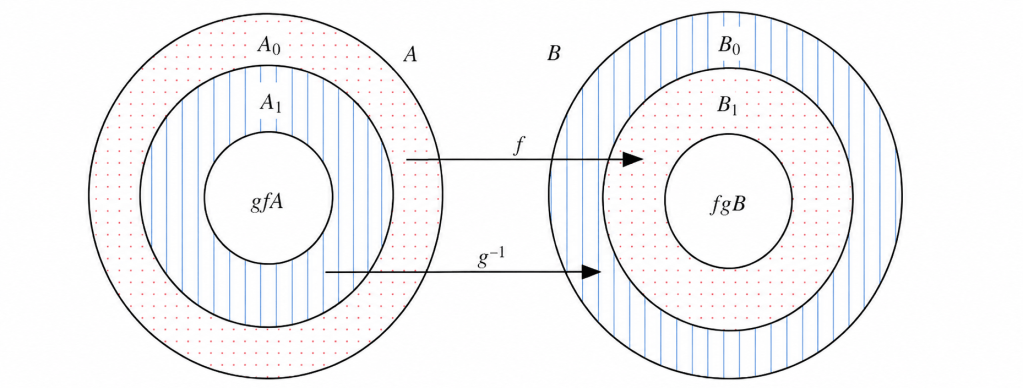
 . They lie in the image of
  since
since  . Similarly,
  to
to 
 .
. to
to  and
and  to
to  .
.  and
and  are disjoint and we have a bijection
  defined by
 and
and  . Clearly
  and
and  . Observe that
  to
to  precisely since these elements do not lie in any of the rings. Hence, we can extend
  to a bijection
  defined by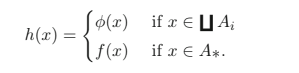
 , we say a prime
  is a prime divisor of
  if
if  . Our goal is to determine the nature of the prime support of a given sequence, and in most cases we wish to show that it is infinite.
 and explicitly construct a term of the sequence which has bounded
  with respect to each of these primes (in practice, usually just relatively prime). As a toy example, to see why the set of all prime divisors of
  is infinite, note that
  is relatively prime to all
  .
. is infinite.
 and let
  denote the term such that
  and say
  .
. . Then,
  (why?) for all such
  (why?). This choice of
  must then have a prime factor outside our assumed set, a contradiction.
 is infinite using the same approach, with Fermat’s Little Theorem as the construction tool.
 adic valuations and size arguments, which is one of the most common tropes throughout problems of this species.
 be an integer. Define a sequence of positive integers by
  and
and  for all
  . Prove that for each integer
  there exists a prime number
  but none of the numbers
  .
. be the sequence such that
  and
and  for all
 . Since
  is clearly coprime to
  has a prime factor which does not divide any of
  for all
  .
. if
if  . To see why, we proceed via induction, for fixed
  for all
 . In fact, if
  we can take the claim one step forward and prove the same result modulo
  . The approach is once again induction, with the inductive step following trivially from the prior equation. For the base case simply note
  so,
so,

 as desired.
 for all
  and
and  being clear, we tackle the inductive step by noting that
 , and the inductive hypothesis applies.
 (why?) and if it is not a new prime factor of the sequence, let
  denote the earliest term such that
  . Since
  and
and  , we have
  .
. it follows that
  (why?) so we further have that
  . However, this is a clear contradiction since if
  we must have
  and
and  which implies
  as well, absurd.
 is infinite.
 is bounded above by some constant
  . The trick is to consider the index of the largest prime power dividing a term
  .
. consecutive terms of the sequence, there must exist
  in the range such that
  .
. such that
  . Let
. Let  , then we have
 and
and  , so
, so  .
.![\sqrt[k]{2017^n} \le p_j^{\ell} \le M \cdot (2017^k-2016^k)](https://s0.wp.com/latex.php?latex=%5Csqrt%5Bk%5D%7B2017%5En%7D+%5Cle+p_j%5E%7B%5Cell%7D+%5Cle+M+%5Ccdot+%282017%5Ek-2016%5Ek%29&bg=ffffff&fg=000&s=0&c=20201002) which is a contradiction as
which is a contradiction as  can be found such that
  is in some sense ‘bounded’ for our choice of
  diverges, then the prime support of
 by the
  has infinitely many prime divisors where
  .
.
 be an integer in base-
 for all
  , as usual. Observe that if
  is the integer obtained by moving the first digit to the end,
 . More generally,
  . Thus an
  is naturally a circular string of digits. Multiplying by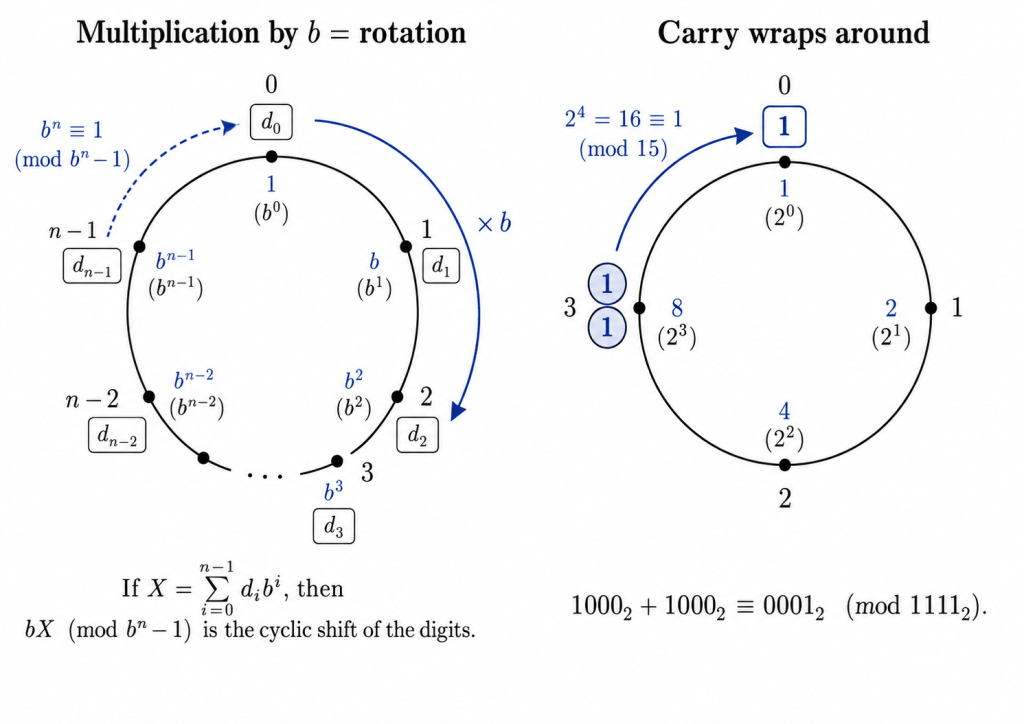
 be positive integers,
  and
and  Show that the representation of the number
  where
where  where
where  is the number of non-zero digits of
  , since each digit is at most
  .
. , the first thing to try is reducing every exponent
  . Replacing
  , we can define
  which since
  implies
  .
. position contributes far more to the sum
  than a digit at the units position. We are trying to bound the number of non-zero digits — which should not depend on their positions, but our inequalities are highly position dependent.
 and
and  . We want to understand multiples of
  , so reducing the powers of
  modulo
  gives
gives 
 . Thus,
  is a multiple of
  , the actual digit sum.
 is a multiple of
  is a multiple of
  , which matches our target.
 , define the sums
 .
. visits each of the
  is exactly
 .
.
 are all multiples of
  so
so  !
! and
and  , define
  to be the total number of times the digit
  between
  ,
,  ,
,  ,
,  .
. where
where  since
since  for this choice of
  digit string, allowing leading zeros. Hence, for any multiple
  of 1829, it’s cyclic rotation
  is equivalent modulo
  and is hence also divisible by 1829.
 through the units position. Hence, we only need to count the number of times each non-zero digit occurs in the units position. However, since 1829 and 10 are relatively prime, the units digit of multiples of 1829 are periodic modulo 10.
  , so each of the digits 0 through 8 occur
  times while 9 occurs
  times, implying that
  , as desired.
 and
and  have the same number of occurrences of each non-zero digit when written in base ten.
 (confirm why!).
 . If we can find
  position, we would be done. Rearranging,
  . However observe,
 but the modern framework of mathematics would never be conceived.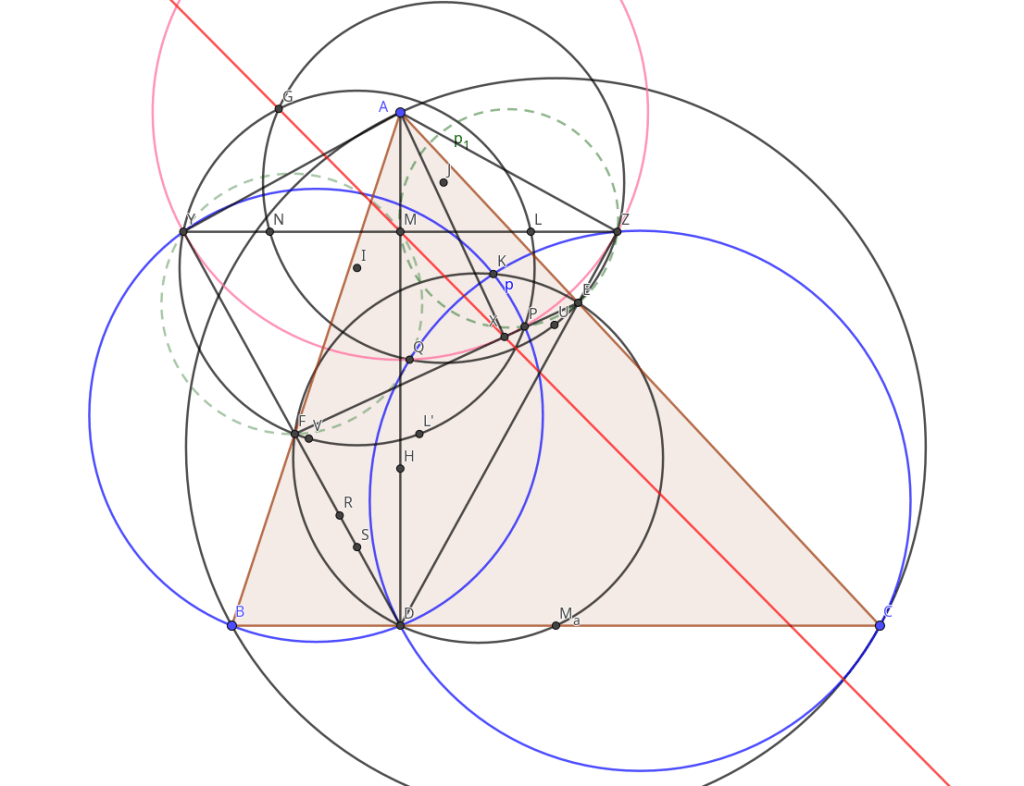
 excircle of the orthic triangle which appeared recently on the Vietnam Team Selection Test. This configuration can be transposed to the standard excircle configuration by shifting the reference triangle to the orthic triangle, but certain results are interpreted more naturally in an orthic setting.
 and that
  and
and  excenters of the orthic triangle.
 of the perpendiculars from
  to the sides
  ,
,  and
and  respectively are the corresponding extouch points of the same triangle.
 and
and  are parallel.
 with
with  and the second intersection
  of line
  with
with  both lie on the
  and
and  are both cyclic. Also, by Reim’s theorem note that the quadrilateral
  is cyclic.
 .
. of line
  with line
  and the intersection
  of
of  with line
  can also be seen to lie on the circle
  via angle chase.
 and
and  respectively. Hence, Power of a Point at
  and
and  are both cyclic, Reim’s theorem implies that lines
  and
and  are parallel.
 and
and  are both cyclic, so it follows that
  as the unit circle.
 ,
,  to triangle
  . Moreover, point
  to
to 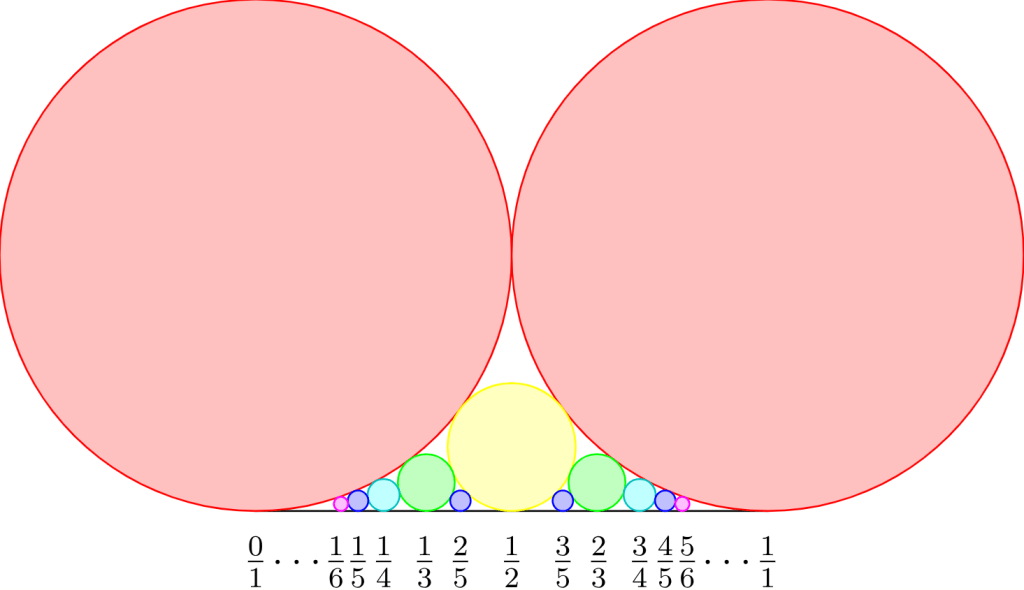
 is the sequence of completely reduced fractions, usually between 0 and 1, which have denominators less than or equal to
  (which is of course obvious from the definition) and since they are completely reduced, the numerators are coprime to the denominators. Thus, there exists exactly
  fractions with denominator
  and indeed, the Farey sequence of order
  terms.
![\frac{1}{2}\left[1+\sum_{i=1}^n \phi(i)\right]](https://s0.wp.com/latex.php?latex=%5Cfrac%7B1%7D%7B2%7D%5Cleft%5B1%2B%5Csum_%7Bi%3D1%7D%5En+%5Cphi%28i%29%5Cright%5D&bg=ffffff&fg=000&s=0&c=20201002) , solving this
, solving this  and
and  are neighbours in a Farey sequence if and only if
  or equivalently,
  .
. in a Farey sequence. We shall determine the next term in the Farey sequence. Since
  , there exists integers
  and
and  satisfying the equation,
 is a pair of solutions, then all pairs of the form
  where
where  is an integer are also solutions. We can now consider
  and look at the pair
  and
and  . Since this is a pair of solutions to the above equation,
  so
so  so
so  be the next term in the Farey sequence
  and we have
 and
and  .
. .
. follows by our choice of
 and throw it on the lattice plane.
 does not contain any lattice points in it’s strict interior. It is not hard to see that the point
  is visible if and only if
  . This means that the set of fractions in the Farey sequences of order at most
  ,
,  and
and  .
. passing through the origin
  since
since 
 denotes the
  and
and  be two points on which lands consecutively. Since there exists no visible points within the angle
  it is not hard to see that there exists no visible points (and hence no lattice points) within the parallelogram
  . By Pick’s Theorem it then follows that the area of the parallelogram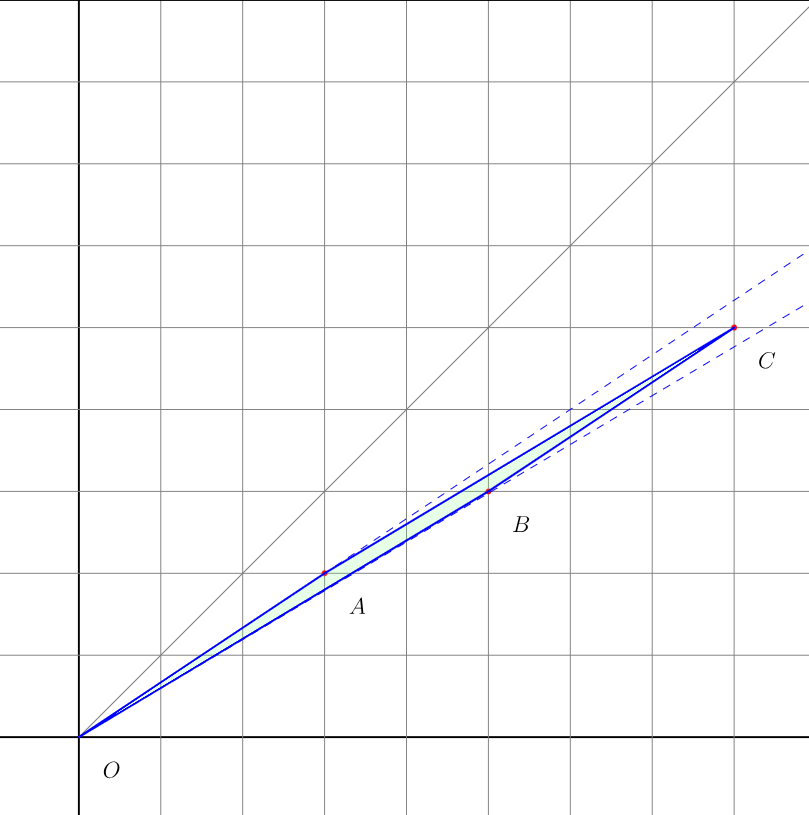
![[OACB] = |x_ay_b-x_by_a|](https://s0.wp.com/latex.php?latex=%5BOACB%5D+%3D+%7Cx_ay_b-x_by_a%7C&bg=ffffff&fg=000&s=0&c=20201002)
 are a trio of neighbours in a Farey sequence, then
  which can be verified by applying the above property on each pair of neighbours.
 must be completely reduced since otherwise, this fraction lies strictly between
  .
. and
and  for some strictly positive integer
  note that
  and
and  so
so
 which since
 and
and  , placed at either end of a segment of length 1, in each step write the mediants of each pair of neighbouring fractions at the midpoint of their positions. Optionally, one can write the fractions generated in each step in a new level. This structure is sometimes refered to as the Stern-Brocot tree (when all edges are deleted except those between a fraction and it’s two children) or the Neighbour’s graph of Farey fractions. Given below is the graph upto 5 generations, with terms greater than 1 included.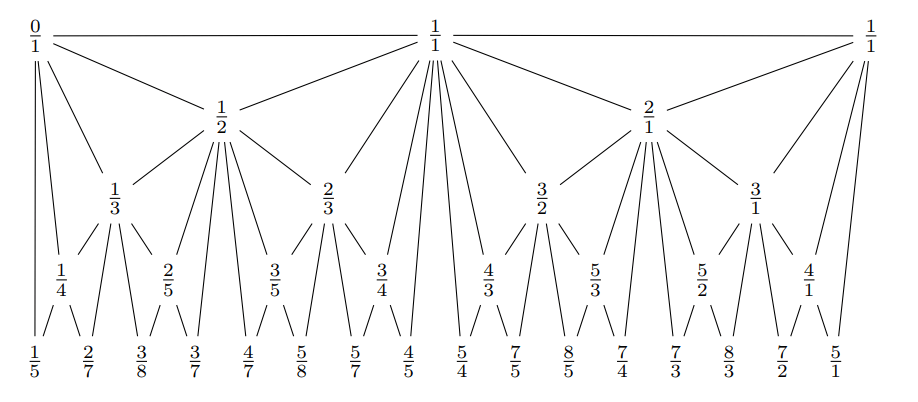
 edges, this immediately solves
  , there exists integers
  with
with  .
. . Clearly,
  is a really good rational approximation but this is pointless. The goal is to obtain as close an approximation as possible, using small denominators.
 , there exists infinitely many pairs of integers
  such that
  .
. , the positive integer
  such that
  and pick the fraction which is closer to
  . The interval
  is of length
  meaning that our approximation is off by at worst
  , as desired.
  that is at most
  off, we need to use a denominator of at least
  which is barely any better than what we started with.
 .
. , it is easy to see that the others follow by shifting. Since
  .
.  ,
,
 and
and  must hold. Moreover, as the order of the Farey sequence increases, every rational number between 0 and 1 appears, and we obtain infinitely many (increasingly better) approximations of
  .
. it is clear that
  ,
,  and
and  hold.
hold.

 and
and  . Summing these two inequalities we have,
  which rearranges to
  which is a clear violation of the trivial inequality unless equality holds. However, equality cannot hold since
  is irrational, and the result follows.
  such that
  . This is because for larger
  ceases to have infinitely many approximations. This is part of the reason why the golden ratio is said to be in some sense ‘the most irrational number’.
 and have radius
  for every completely reduced fraction
 or simply
  which is a clear contradiction, and in particular tangency holds if and only if
  which is precisely the Farey neighbours condition.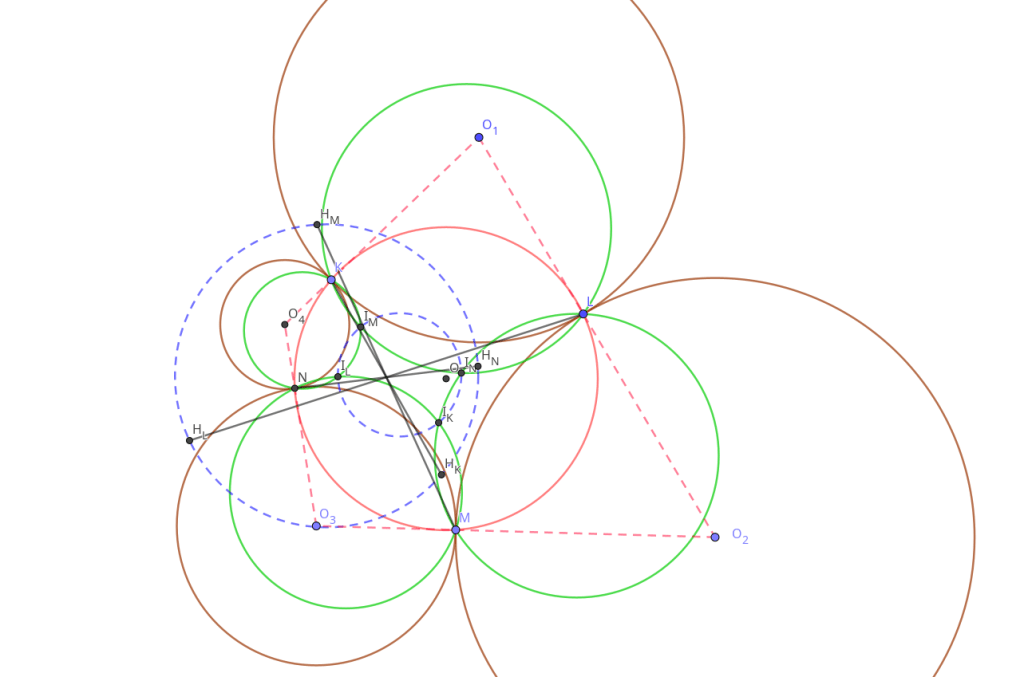
 ,
, ,
, and
and  (with centers
  ,
,  ,
,  and
and  ) to be four circles such that
  and
and  are externally tangent for all
  where indices are considered
  .
. denote the tangency points of each pair of circles. An easy angle chase or an inversion about
  is degenerate or cyclic, which is
  to
to  to
to  is equal to the sum of the radii of the circles, by Pitot’s theorem it follows that
  is the internal
  bisector and similarly, so it follows that the circumcenter
  and
and  are pairs of equiradial circles. In particular, when this happens
  . In this case, the antipodes of
  and
and  denote by
  the incenter of the triangle formed by the other three points.
 (and similarly) is concyclic with circumcenter coinciding with the minor
  arc midpoint in
  are right and hence a rectangle.
 the orthocenter of the triangle formed by the other three points.
 (and similarly) is concyclic, and that quadrilateral
  is also concyclic.
 (and similarly) are all parallelograms, which implies that the segments
  ,
, ,
,  and
and  concur, bisecting each other. This claim is in fact also true for any set of four concyclic points.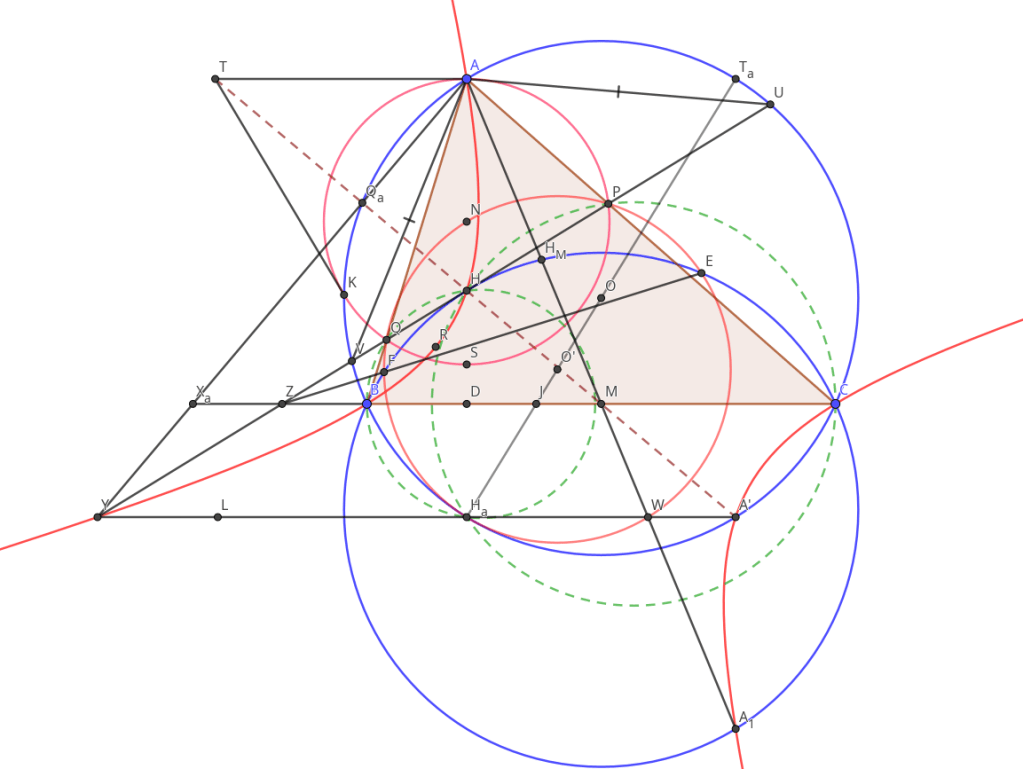
 at
at  . Many thanks to Yangqin Yang for contributing several proofs and for saving me from crashing out.
 ) and a GeoGebra link is embedded to the diagram below for closer inspection.
 it follows that lines
  ,
,  and
and  diameter of
  .
. is tangent to
  we have that
  with respect to
  is also harmonic and hence projecting onto line
  with respect to
  and
and  are also cyclic.
 . Pascal’s theorem on coconic hexagon
  implies that lines
  and
and  concur, which since the latter two are both perpendicular to side
  and hence points
  then
then  is also cyclic by PoP at
  also lies on this line due to the right angles.
 and
and  are also cyclic which by an easy angle chase shows that the midpoint
  lies on
  .
.
 . This inversion swaps the pairs
  ,
,  .
.  and
and  due to the cyclic quadrilaterals noted above.
 with circle
  which solves the following
  . Combining this with the previous result it follows that quadrilateral
  is cyclic with center
  is well known to be cyclic, it follows that
  is too by Reim’s theorem. Thus, this inversion swaps points
  . In particular, this implies that
  . Thus,
  which is the line through
  must map to the
  and
and  are tangent to
  we have
  implying that
  is the polar of
  lies on the polars of both
  is the polar of
  so it follows that lines
  and
and  are parallel. In particular, this means that
  which must imply that
  is the polar of
  bisects segment
  denote the rectangular circumhyperbola of
  and
and  is parallel to
  ,
,  and
and  are collinear which by the converse of Pascal’s theorem implies that
  and
and  are collinear implying that the points
  are coconic.
 by reflection, it is clear that lines
  and
and  intersect on
  are collinear. By reflection across the line
  is cyclic, on which
  is a kite due to symmetry.
 is cyclic. Further, the above observation implies that
  is cyclic, which implies that lines
  ,
,  concur.
