Today we shall have a look at a generalized configuration, with certain noteworthy special cases. Problems from this configuration seem to not yet have appeared in olympiads, with the only problem I am aware of being due to Ethan Wang. Also, shoutouts to Yanqing Yang for several key ideas and claims.
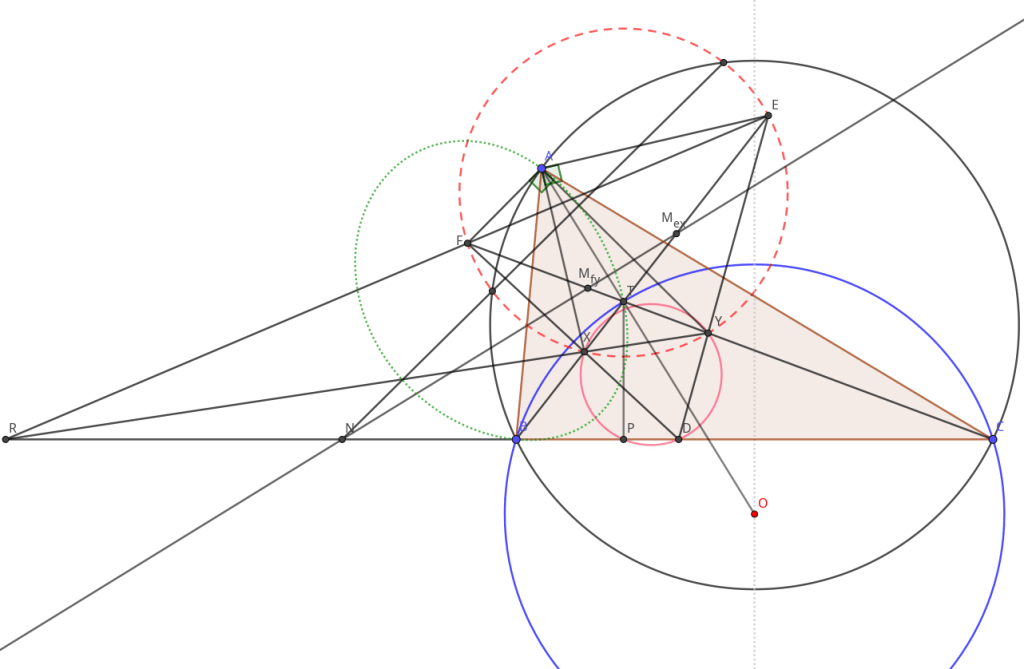
Since most points are unfamiliar, we shall first take a moment to define all points used in the above diagram (the following title is a drop-down list).
Definitions
Let be a fixed arbitrary circle passing through and with center . Let denote the point on segment and . Let denote the intersection of the internal bisector with . Let and denote the intersections of the internal bisector and bisector with segments and respectively. Let denote the intersection of lines and . Let and denote the intersections of lines and and lines and respectively. Let be the foot of the altitude from to and is the midpoint of segment .
We shall follow the point definitions in the above diagram, to which a clickable GeoGebra link is attached.
A summary of the key results pertaining to this configuration,
First, an easy lengths calculation (for example Menelaus’s theorem) shows that lines , and concur. From the Ceva/Menelaus picture it then follows that . This also implies that .
Projecting through and it follows that and respectively.
Now, applying Prism lemma we have that lines , and concur at .
An easy angle chase shows that lines and are isogonal with respect to .
Then, Desargues Dual Involution theorem at on quadrilateral implies that the pairs and form an involution. The former two imply that this involution is reflection across the internal bisector, so it follows that and are isogonal with respect to .
An alternate proof of this isogonality is to note that since and is the internal bisector, we must have and similarly, .
Note that since , it follows that lies on the polar of with respect to . The self-polar orthogonality lemma now implies that the circle with diameter is orthogonal to , and similarly the circle with diameter is orthogonal to .
As a result, inversion about keeps both circles and fixed, implying that their radical axis contains .
Moreover, we know from the previous bullet point that lies on this radical axis as well, so is the radical axis of circles and .
Since also lies on this line, it follows that and thus must be cyclic. In particular, this means that .
With the claim that is cyclic, we can invoke well-known results on the complete quadrilateral .
For example, this means that is the Aubert line of complete quadrilateral , so the orthocenters of and must both lie on the line .
Further, the Miquel point of quadrilateral is the foot from to , which implies that lies on all of the circles , , and .
Also, it is well known that , so lies on the radical axis of circles and .
The special cases when coincides with the midpoint of segment and minor/major arc midpoints of are noteworthy.
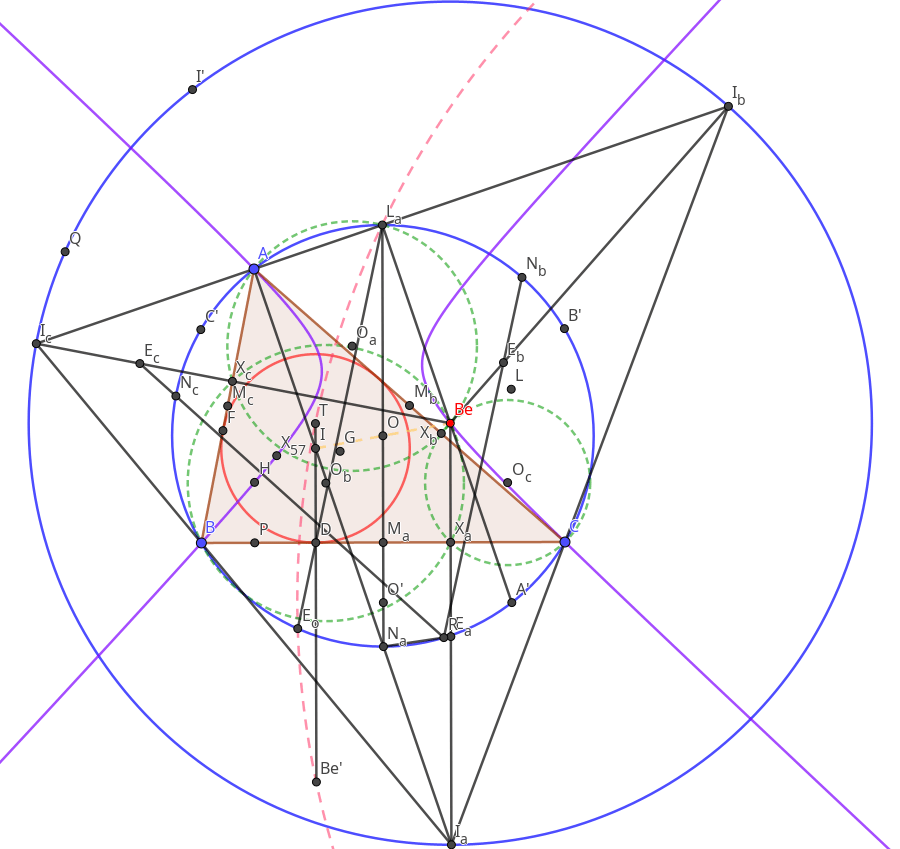
Today we shall look at something different from usual, and turn our attention to a famous triangle center, named after Benjamin Bevan — the circumcenter of the excentral triangle or the Bevan point , which is Kimberling triangle center . A reasonable amount of work (mainly analytical) has been done regarding this point during the early 20th century, although it has not yet been featured extensively in mathematical olympiads.
Notation will comply with the point definitions in the above diagram, to which a clickable GeoGebra link is attached.
A summary of the key results pertaining to this configuration,
First observe that since and are the orthocenter and nine-point center of the excentral triangle respectively it is well known that the Bevan point is the reflection of the incenter of across its circumcenter.
Returning to the definition, since in intouch and excentral triangles are homothetic, it follows that their center of homothety lies on the line which solves 2003 Vietnam TST Problem 2.
Also, quadrilateral has diagonals which bisect each other, implying that it is a parallelogram. Since is the midpoint of segment we also have that quadrilateral is a parallelogram.
Due to this reflection, it follows that where is the Sharkydevil point of , which is the crucial claim for 2013 ELMO Shortlist G2.
Since it is well known that the circumcenter and orthocenter are isogonal conjugates, is the isogonal conjugate of in the excentral triangle and hence, and similarly. Shifting our reference triangle from the excentral triangle to we immediately have 2015 Macedonia MO Problem 1.
Finally, if are the minor arc midpoints in , by the Incenter-Excenter lemma we know that is the midpoint of segment and similarly. A homothety centered at with scale factor 2 now implies that the reflection of across the midpoint of lies on and similarly, which disposes of this problem by betongblander.
Denote by and the , and antipodes in . Since it follows that so by the Mean Geometry theorem the midpoint of segment lies on the perpendicular bisector of segment .
A homothety centered at with scale factor 2 sends this perpendicular bisector to the line proving the collinearity of these lines.
Further, quadrilaterals and similarly are cyclic due to the right angles so their centers are the midpoints of segments and similarly. The previous observation then implies that the lines through parallel to the internal bisector and similarly all pass through the circumcenter , which solves 2023 Bulgaria MO Problem 2.
Since is a rectangle and is equidistant to and it follows that is the arc midpoint which contains . Hence, is the internal bisector which in conjunction with the previous observation implies that is the incenter of .
Moreover, a homothety centered at with scale factor 2 maps the medial triangle to the antipodal triangle and hence the Spieker center to the Bevan point , proving the well known fact that is the midpoint of segment , which has appeared in a contest from Bulgaria in 2004.
Further, a straightforward angle chase shows that quadrilaterals and similarly are all concyclic.
Since the diagonals of quadrilateral bisect each other at where is the de Longchamps point of , it must be a parallelogram. Since we proved previously that is the midpoint of and it is well known that is the midpoint of , it follows that is also a parallelogram. So, points and are collinear.
It is well known that points and all lie on the Nagel line of with and (homothety centered at the centroid mapping the reference triangle to the medial triangle) so . Projecting through it follows that is the midpoint of .
Returning to the reflections of across the midpoints and , observe that passes through . A homothety centered at with scale factor 2 maps this to the circle .
A homothety at with scale factor followed by a homothety at with scale factor 2 maps to which is well known to be similar to . Hence it is clear that .
Thus, is the center of spiral similarity mapping segment to and hence also the center of spiral similarity mapping segment to . Spiral similarity properties imply that lies on . Applying this on all three sides it follows that and concur on , which is the statement of 2020 International Festival of Young Mathematicians Grade 10-12 Problem 6.
With a bit more work, one can also show that this concurrence point is the orthopole of with respect to the excentral triangle.
Let and denote the intersections of with such that is on the same side of as . Since it is well known that is the reflection of across the midpoint of segment , it follows that is an isosceles trapezoid. In particular, this implies that is the antipode in .
Hence, a homothety centered at with scale factor maps to the perpendicular bisector of segment , so it follows that quadrilateral is an isosceles trapezoid.
It is well known that points and are collinear where denotes the Evan is Old point. Hence, it is not hard to see that quadrilateral is concyclic by Power of a point at .
Now, an easy angle chase shows that points and are collinear, and since it is well known that the homothety center of the intouch and excentral triangles, lies on the Evan is Old cevians, also lies on this line which settles Problem 95 from i3435’s Muricaaa.
Note that where is the foot of the altitude lies on by the radical center theorem.
It is not hard to see due to isogonality and rtbc inversion that . Then an easy angle chase shows that points and are collinear.
A further angle chase utilizing this similarity shows that is cyclic, which implies that also lies on the circle established in the second bullet point, which is a central claim to both 2018 ELMO Shortlist G5 and 2024 IGO Advanced Problem 3.
Several applications of the Pythagorean theorem show that the Bevan point satisfies the length condition , which appears in 2003 IMO Shortlist G3 which claims that the Bevan point is the unique point which satisfies this condition with respect to it’s pedal triangle.
The Darboux cubic is known to pass through the points , , the orthocenter , the incenter the circumcenter , the infinity point along the -altitude , the de Longchamps point (which is also the pivot), and the Bevan point and since is the pivot, through the point .
By Cayley-Bacharach on , and , it follows that points are coconic.
By Pascal’s theorem on the coconic hexagon it follows that points , and the intersection of the reflection of across the midpoint of and are all collinear, solving this interesting problem from Twitch Solves ISL by DottedCaculator.
Today we shall look at a rather interesting configuration which has appeared in only a handful of problems to date with rather surprising and occasionally obscure results. Our work shall explore the tangents from the point which is defined as the intersection of the tangents from and to the circumcircle of .
As usual, notation is borrowed from the diagram attached above, with most familiar points carrying their standard labels. In case of an unclear definition, the above diagram is linked to a GeoGebra file which can be referred.
A summary of key results pertaining to this configuration,
First, the points and are the tangency points from to the incircle .
Pascal’s Theorem on concyclic hexagons and show that points , , and all lie on the same line.
Pascal’s Theorem on concyclic hexagons and show that points , , and are collinear. Thus, the line through and is tangent to at .
Finally, Pascal’s Theorem on concyclic hexagons and implies that points , , and are collinear.
Combining all these applications we conclude that the tangent to at contains points and and passes through .
Let and be the tangents from to . Since lies on the polar of with respect to , by La Hire’s lies on line .
Projecting from onto the circumcircle we note that is harmonic, so points , and are collinear.
Further, since is the harmonic conjugate of with respect to segment a projection at implies that lies on .
Pascal’s Theorem on concyclic hexagon yields that lies on .
By Brokard’s Theorem on cyclic quadrilateral it follows that lies on the polar of with respect to . Thus, lines and all concur at .
This implies that and projecting through onto the circumcircle, we have that is harmonic.
In particular, we have that and are the polars of and with respect to respectively, which is the key result in Shortlist 2019 G6.
By Poncelet’s Porism it follows that is tangent to . Combining this with our previous observation it follows that and lie on the tangent from to , solving this intriguing unsourced problem.
Since , projecting through we have that lies on the polar of – the intersection of the tangent to at and , with respect to the incircle.
Since lies on the polar of , by La Hire’s it follows that lies on the polar of with respect to which implies that the tangent to , line and concur at .
Thus, also lies on the polar of with respect to the incircle, implying that , the second tangency point from to lies on .
Hence, projecting through we note that is harmonic which also implies that points , and are collinear. This immediately also implies that lines and concur at which solves 2025 December MEOW Problem 6.
Applying Pascal’s Theorem yet again on concyclic hexagon and implies that points , and are collinear and thus points and are conconic.
A further application of Pascal’s Theorem shows that and also lie on this conic.
Further, sets of points and are also conconic which is easy to confirm via Pascal’s Theorem.
Let denote the foot of the altitude from to the tangent. Since is the polar of with respect to the incircle, is the inverse of under an inversion about the incircle.
Hence, which implies that quadrilateral is cyclic. Further, which implies that quadrilateral is also cyclic.
Since the pedal circles of isogonal conjugates are well known to coincide, this implies that is the isogonal conjugate of with respect to since is clearly the internal bisector. This wraps up 2024 Vietnam TST Problem 5.
Incidentally, this also implies that is the center of spiral similarity mapping segment to .
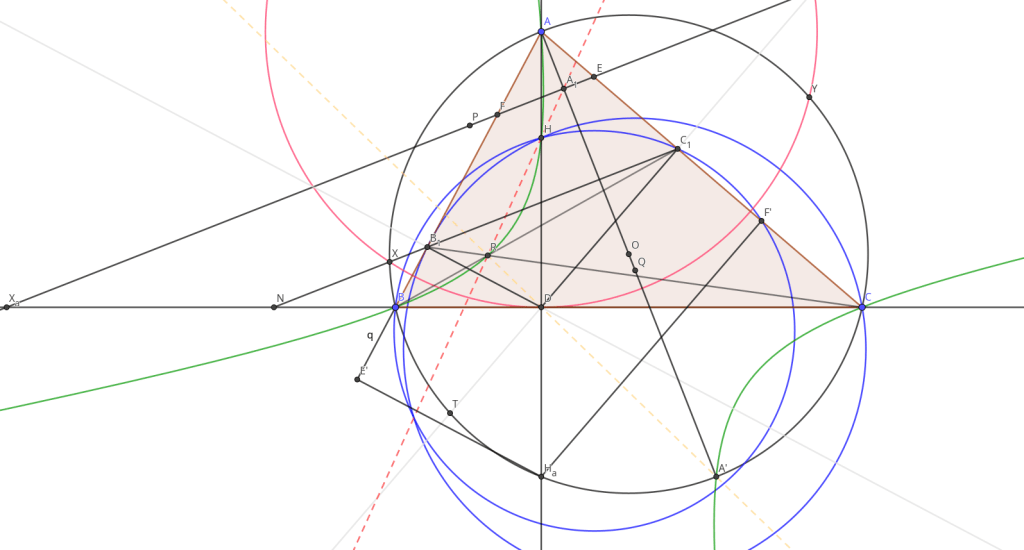
Today we shall have a look at a simple configuration which is moderately prevalent in modern Olympiads but has not received much attention. Our work shall involve the feet of the perpendiculars from the foot of the altitude to the sides and .
As usual, notation is borrowed from the diagram attached above, with most familiar points carrying their standard labels.
A summary of key results pertaining to this configuration,
First, an easy angle chase yields cyclic. Hence, by Reim’s it also follows that . Moreover, this means as well. Also, it is clear that is cyclic due to the right angles.
Let and be the feet of the altitudes from and to line respectively. Clearly, and are both cyclic.
Since is the incenter of , it then follows that . Similarly, which implies that is the reflection of across line .
As noted before, so it follows that bisects segment .
Further, the reflection of across must lie on the line through parallel to and hence, it lies on the circle with diameter . Thus, is the orthocenter of .
Next, consider the inversion centered at with radius . This swaps with and with . Hence, and as well as are fixed under this inversion.
This implies that and thus is the center of . Moreover, since this circle is tangent to at .
Note that since is concyclic, it is clear that the isogonal conjugate of with respect to lies on the perpendicular bisector of . In particular, this claim generalizes to any antiparallel to .
It is not hard to see that the isogonal conjugate of the antipode with respect to is the point at infinity along . Hence, lies on the rectangular circumhyperbola of passing through .
Pascal’s Theorem on conconic hexagon then implies that lies on the line through perpendicular to which by our previous observation that is the orthocenter of implies that points and are collinear, which is a key claim in several approaches to 2016 USA TSTST Problem 6.
Since is cyclic it is also clear that points and are equidistant from .
Thus is the perpendicular bisector of segment which implies that quadrilateral is a kite, and hence harmonic.
Applying Pascal’s Theorem once more on conconic points implies that lies on the line through perpendicular to . Hence, points and are collinear.
Hence, projecting through gives us and a further projection through shows that points and are collinear.
This immediately shows that points and are concyclic due to the right angles.
Furthermore, the feet of the altitudes from to the sides and must be the reflections of and across and respectively.
Hence by the Mean Geometry theorem it follows that as well, so by Reim’s theorem must also be cyclic.
Furthermore, since the line through parallel to is the reflection of the line through parallel to through line it follows that the orthocenter of is the intersection of lines and the line through parallel to .
Returning to a previous claim, this implies that lies on . Hence, by Pascal’s Theorem on coconic hexagon it follows that lies on the line through perpendicular to .
Combining this with the previous observation, this implies that is parallel to , solving 2020 Fall Senior DPC Problem 4.
The concept of discrete continuity is an extremely effective and versatile method in tackling a wide variety of combinatorics problems. This technique has been used extensively for many years especially in particular classes of problems. Here, after a quick recap of the basics we shall look at the solutions to some of the more interesting problems from the Practice Problems section of the handout.
The idea behind the notion of discrete continuity is that if an integer valued function changes by at most one at each step it must be surjective within its range.
A common style of problems which falls prey to this technique are number theory problems which ask you to show there exists a string of consecutive integers of which exactly satisfy a desired property for some choice of .
The recipe for these problems is quite simple – show there exists strings of consecutive integers with at least and at most integers which satisfy respectively, and use the discrete intermediate value theorem to win.
A natural number is said to be crazy if and only if there exists positive integers for which . Show that there exists a set of 2014 consecutive natural numbers of which exactly 2012 are crazy.
We look at the function which records the number of crazy integers in the set .
Let a number be called sane if it is not crazy. Note that since 1,2,3,4,5 are all sane due to size restrictions, . Furthermore, for all positive integers we have which is clearly crazy. Hence, .
Now comes the punchline – since (think about why this is true), and there must have been some point where was exactly equal to 2012.
Part of the reason why this method is so effective is that it is an existential technique. It guarantees the existence of objects satisfying the criteria you need without explicitly mentioning what they are. For example, in the above problem we don’t even have any idea about the size of the set of 2014 consecutive integers which work (except that it lies between the two extremes – 1 and .
Next, we shall look at an interesting problem which appeared on the 2004 Putnam.
Basketball star Yang Liu’s team statistician keeps track of the number, , of successful free throws he has made in his first attempts of the season. Early in the season, was less than 80% of , but by the end of the season, was more than 80% of . Was there necessarily a moment in between when was exactly 80% of ?
The key idea is to define the function .
Before we proceed, a natural question to ask is – ‘why this function?’. The answer is simple. It is zero precisely when was exactly 80% of . It is in a sense, a measure of how ‘close’ a moment is to being an 80% success rate.
Our hope is that would satisfy discrete continuity. Indeed, when Liu makes a successful throw both and increase by one, causing to increase by one as well. However, when Liu fails a throw, increases by one without changing causing to drop by four.
Clearly, does not satisfy discrete continuity, so are we cooked? Thankfully, no! In fact, we do not care how decreases. Since may only increase one at a time, and we know there is a moment when moves from below to above 80% of , must have been exactly zero at this moment.
An interesting thing to note is that this solution only worked since is the ratio of two consecutive integers. For example, if 80% were replaced by 60% the argument would break since the corresponding function would then be which does not satisfy discrete continuity when either increasing nor decreasing, so it is possible for to jump right over zero.
Consider a set of points in the plane, no three collinear, and the triangles with vertices in . Prove that some point in the plane lies in the interior of at least of these triangles.
What I like most about this problem is that at a glance discrete continuity is an idea that you would never come up with – even if you had 14 bottles of 34% w/w hydrochloric acid to drink last night. Global approaches like pigeonhole seem more promising.
However, experimenting with small cases we make an interesting observation – the ‘center’ of the distribution of points always seems to work. That is, if we consider two lines which divide the plane into four regions such that there are exactly points (note how the total number of points was conveniently set to ) in each quadrant of the plane.
The idea is that if we pick one point from each quadrant, the resulting quadrilateral has at least two triangles pick cover , simply because must lie strictly inside the quadrilateral. Thus, there exists at least,
triangles which cover the point .
With this observation in hand, we have suddenly turned the tides – this is simply a stronger version of Example 11 in the handout!
We first show that for any line in the plane, there exists a line which is parallel to and has exactly points on each side of it. This is clear since starting with a line parallel to not intersecting the convex hull of our set of points, we may push it along until we pass right through the convex hull.
We begin with points on each side of the line and end with implying that by the discrete intermediate value theorem, there exists some intermediate moment where the line split the set of points into two equal groups.
We can also tweak this argument to divide the plane into four quadrants. Simply fix a line and let a variable line start off as and rotate clockwise continuously until it makes a half rotation.
At any moment, and split the plane into four regions. We begin with the regions having exactly points each and end with them having points each implying that at some moment we must have had exactly points in each quadrant, which is exactly what we wanted.
In this article, we shall explore some properties of the intersections two highly celebrated circles in the world of Olympiad geometry. Although the individual circles are thoroughly explored and considered mostly ‘well-known’, the configuration involving their intersections is still relatively unexplored, with only two notable examples appearing on an Olympiad to date, as far as I am aware.
We shall follow the notation given in the above diagram, with most points carrying their traditional labels.
A summary of the key results pertaining to this configuration,
First, we can consider the inversion centered at with radius followed by a reflection across point . This swaps with and with . Hence, and as well as and are inverses of each other.
This immediately implies that points and and points and are collinear.
Further, this yields which indicates that , and similarly is cyclic.
Since it is well known that is cyclic, this also implies that passes through .
Next, look at the inversion centered at with radius . This swaps with and with . Hence, points and all invert to themselves.
Hence, so quadrilateral is cyclic with center .
Moreover, since , the quadrilateral is a kite and is thus harmonic. Projecting through onto line immediately implies that which is sufficient to conclude that the polar of with respect to passes through the intersection of lines and which solves this problem by Kudo3105.
Finally, look at the inversion centered at with radius . This swaps with and with (remember ). Hence, this swaps points and and similarly swaps points and .
We now have that points and and points and lie on the same lines. This combined with our first observations finishes 2016 Canada MO Problem 5.
From our first observation that points and are collinear, it follows that quadrilateral and similarly quadrilateral are cyclic.
Further, we have so quadrilaterals and are both cyclic.
Similarly, which implies that quadrilaterals and are both cyclic.
Finally, which implies that quadrilaterals and are also both cyclic.
Also worth noting is that by Brokard’s Theorem on cyclic quadrilateral we have that is self polar with respect to .
Using both the above main results we can then show with a little angle chasing that quadrilaterals and are cyclic.
Considering the aforementioned inversion at , this implies that quadrilaterals and are cyclic.
By Radical Center Theorem on circles , and it follows that lines and concur at .
A straightforward angle chase now allows us to show that lies on and similarly lies on , which solves 2024 German MO Problem 3.
From our previous observation that it follows that and hence . An alternate proof is to apply Pascal’s Theorem on concyclic hexagon .
Furthermore, by Reim’s Theorem it hence follows that quadrilateral is cyclic.
Using harmonics it is not hard to see that lies on the line through and .
In this article we provide investigate a famous classical process involving piles of stones (or originally cards) introduced by Martin Gardner.
The game involves a set of piles of stones with stones in total. In each move, the topmost stone in each pile is picked and a new pile is formed with these stones. The goal is to show that eventually we end up with piles of stones with stones in them respectively.
Despite the overwhelming amount of work on this topic, it was almost impossible to find a clear and intuitive solution which appreciates the beauty of this process. The following solution is due to Tony Wang.
1. Setting up an attack
In order to attack the problem, we first need to come up with some representation or setup which allows us to record the variation in the distribution of piles.
The most natural way to do this is to represent each stone as a dot, and let dots be in the same column if they are in the same pile. Now, we have a choice to make on how we represent the movement of stones. For example, we can always place the new pile in the rightmost position.
In each case, the highlighted stones are those which are picked to form a new pile.
However, one realizes it is extremely difficult to understand how the piles that using this representation, partly since the piles which ‘disappear’ leave empty columns. Always rearranging the piles so that they are in decreasing order of size is even more obscure since the position of each new pile is already hard to control.
To fix this issue we utilize the following process to go from one position to the next.
Algorithm : Let denote the line parallel to the line which passes through the lattice point to the immediate left of the leftmost point in the bottom row. Reflect the bottom row across and move the entire system by a vector of .
It is clear that this corresponds to the given operation since the bottom-most stone in each column ends up in the leftmost new column. However, one might notice that this leads to situations when there are columns with spaces in between stones. Since this is awkward, we imagine the stones to be in a world where gravity exists and the stones fall down. So, a stone will occupy the lowest position available in it’s column.
Repeating the previous example using this algorithm,
Using this representation, we show the stronger claim that not only will the piles eventually be of sizes but they will lie precisely within the region bounded by the lines , and .
2. ‘Inventing’ information to track
Increasing the amount of information available for tracking is an incredibly powerful tool since it allows us to treat the system more ‘rigidly’. In this case, allowing the stones to be indistinguishable leaves a lot of ambiguity about which stone goes where, so to increase the rigidity of the system we treat each stone independently.
The trick is now to look at the trajectories of each individual stone, and the reason why the above representation is so powerful is simply because it allows us to achieve this goal beautifully.
For example, the stone at always stays there since the reflection sends it to and the displacement vector sends it back to where it started. In fact, this is precisely the way to motivate this representation – it ‘anchors the base point’, so to speak.
To make things more clear, we shall repeat the previous example, this time highlighting each distinct stone in a different color.
Let a diagonal be a line parallel to the line . Looking at the above picture, we can make two key observations.
Each stone cycles within the diagonal it lies in, so its ‘diagonal number’ is non-increasing.
Furthermore, if a stone lands in a position which has no stone underneath it, by gravity it falls down to a smaller diagonal.
We shall now work out the finer details of these two heuristics.
3. Fine tuning and Proofs
If a stone is not at the bottom row, it simply moves by the vector and hence stays within the same diagonal (assuming it does not fall down). If a stone is at the bottom row, then it moves from to which are in the same diagonal (once again assuming it does not fall down).
Now, in order to finish, we simply need to show that it is impossible for some stone to never fall down if it has to.
Consider the smallest isosceles right triangle with a vertex at which is completely filled. Say there exists some lattice point in diagonal which is not occupied (called a hole, say ), and at least one stone outside the filled triangle and diagonal .
Clearly at least one of these stones (say ) lies on diagonal (since stones must fall down if they are able to). We claim that this stone eventually fills the unoccupied point in diagonal . As noted before, each stone of diagonal cycles within the diagonal, moving one position during each move, and hence has period . If the stones cycle with period and the holes remain unfilled, then the holes also cycle with the same period. Similarly, the stone in diagonal cycles with period .
However, since eventually (within moves) the hole and stone must line up, at which point occupies the position of the hole, which contradicts our assumption that remains a hole.
Hence, any holes must be filled in a finite number of steps and indeed we are left with the perfect triangle configuration, as desired.
Today we will revisit a rather old but underrated configuration which has certain beautiful properties. Our work shall revolve around the points on and on such that and points and lie on a straight line.
Shoutouts to raosicheng for suggesting an overwhleming majority of these problems and mathematical_arceus77 for posting most of them on AoPS.
Here is the picture we shall be referring to.
A summary of the most important lemmas from this configuration,
First, circle passes through the Queue point which has been questioned previously, most prominently in Shortlist 2005 G5.
An immediate result is that points , and – the circumcenter of are collinear since they all lie on the perpendicular bisector of segment .
Hence, is the center of spiral similarity mapping segment to . This then allows us to conclude that quadrilaterals and are both cyclic.
As a result it follows that points , and are collinear.
It is not hard to see that is the external angle bisector. Let and be the intersections of with lines and respectively.
Quadrilaterals and are both cyclic, and in particular tangent to line .
Now, a straightforward angle chase implies that and which is the key result in 2021 EGMO Problem 3.
Returning to the previous spiral similarity, this means that lines and as well as lines and concur on .
An easy angle chase implies that points , and are collinear.
Thus, the aforementioned spiral similarity maps to and to .
Hence, and .
Also this spiral similarity maps to the intersection of with so lies on the perpendicular from to , a genarlized version of which is given in this problem from China.
Some harmonic bundle chasing using the above claim then implies that quadrilateral is harmonic.
Noting that the internal bisector is the perpendicular bisector of segment we have that . Thus, this claim implies that is the intersection of the tangents to at and , finishing off 2019 Polish MO Problem 1.
This also implies that lines , and concur.
Throwing in the second intersection of line , we can obtain several claims via pure angle chasing.
Quadrilaterals , , , and (pentagon) are all concyclic.
Line can also be observed to be the internal bisector.
The line passes through several key points. For starters, an easy angle chase shows that it passes through the trapezoid point.
After a rt-bc inversion, one can show that lines and concur on this line as well which solves the following very enjoyable problem.
A related configuration can be seen in this problem, where an analogue of the second bullet point in Claim 4 above holds, for the circumcenter.
Today we will explore the properties of a certain well-known point with respect to the intouch triangle. The Why Point, originally seen in the famous 2011 G4, is a thoroughly explored configuration with a plethora of interesting properties. Among the many perspectives of the Why Point configuration is the Why Point of the Intouch triangle.
Here is the picture we shall be working with.
A summary of the key results pertaining to this configuration,
First, the circles and pass through the reflections and of across points and respectively.
Now PoP at shows that is the radical axis of these two circles.
Their second intersection lies on , which is a straightforward angle chase.
In particular, a key step is that by Midpoint Theorem the line through the reflection of across and point (which passes through the antipode in ) is parallel to , which is the statement of STEMS 2020 B4.
Further, the circles and pass through the and Evan is Old Points respectively.
Most notably, inversion sends this configuration to one involving the mixtillinear excircles which are mostly easier to handle.
An easy angle chase shows that is cyclic from which Radical Center Theorem on circles , and we have that lines and intersect on .
The converse of Pascal now implies that points , , , , and are conconic.
Shooting Lemma now yields the most famous Shortlist 2002 G7 which tells us that circle is tangent to at .
The pairwise radical axes of circles , and concur at , the homothety center of the intouch and excentral triangles which is essentially RMM 2012/6.
To see why the point defined as the tangency point of (the circle through and which is tangent to ) and is the Why Point of ,
Inversion about the incircle maps to where and are the midpoints of segments and , whose tangency point to the circumcircle is the Why Point as per Shortlist 2011 G4.
Now, a homography mapping the centroid of the intouch triangle to it’s circumcenter while preserving the incircle tells us that lines , and are also concurrent.
Furthermore, if is the reflection of across line and similarly, lines and concur at the centroid of , which is Basic Problem 026, used by Google Deepmind.
Now, revisiting Fake USAMO 2020/3 we have that lines , and also concur at this homothety center .
Throwing in to the picture, which we know is the symmedian point of we have that the reflections of across the sides of lie on , and which solves Brazil MO 2013/6.
Also of interest is the tangent to at . Pascal’s Theorem on concyclic hexagon shows that the second tangent to at and the tangent to at intersect on the line through parallel to line which is the key result in MODS MO 2021/7.
This article will explore a relatively new configuration which I have talked about extensively in my handout Neat Config which was crafted from a series of notes made by Om Kutte for lectures conducted by him at the (Unofficial) Indian National Mathematical Olympiad Training Camp.
This is the master diagram. All the point definitions (and most of the key claims) are shown in this picture. However, in the case of an unclear or confusing point simply refer the attached handout.
Here is a summary of the key properties that we discovered.
First, lines , and concur at (radical center). Further, Miquel properties tell us that and are cyclic. Also a straightforward angle chase then shows that lies on and the tangent to at .
Next, by Pascal’s Theorem on the intersection of the tangent to at and , lies on line . Since is harmonic (project through I!) it follows that also lies on the tangent to at . This point plays a great vouge in mixtillinear incircle problems. Particularly,
Lines and are parallel. This is essentially 2006 Russia Regional Grade 11/4 and this parallelism has been explored in mixtillinear contexts in many other sources.
Point lies on circle while points , and are collinear.
Line and circle intersect a second time on the line from which it follows that is the second tangent from to . This statement is equivalent to Israel TST 8 2022/3 which is one of the few truly non-trivial problems that have been composed in relation to this configuration.
Lines and are parallel. This property generalizes when is replaced by an arbitrary point inside the triangle and can be easily proven via homothety arguments.
Using the converse of Pascal’s Theorem on allows us to show that points , , , and lie on a conic which encapsulates a lot of weird concurrency claims that can be seen. Applying a more general result on quadrilateral circumconics passing through the Miquel Point (by yours truly!) indicates that point also lies on this conic.
Now we can apply Pascal’s Theorem on coconic hexagon to observe that points , and are collinear (this may require the previous claim).
Another set of coconic points surface as , , , , and turn out to lie on the same conic.
The intersection of ray with circle seems to be the most promising point in this picture. Rushing during the last days of the handout we left this point relatively unexplored.
Both quadrilaterals and are cyclic. Utilizing this a simple angle chase leads to the claim that points , and lie on the same line.
Also ray intersects on the line through parallel to side .
Line also pops up in other more well-known configurations. It is most effective to apply Radical Center revolving around these points.
Points , , , and lie on the same circle since is the radical axis of circles and .
Theorem 2.7.2 on i3435’s Muricaaa states that lines and are perpendicular to each other.
The angle bisector Miquel point also has connections with the symmedian and median. With some simple angle chasing and a sprinkle of harmonic bundles one can show several claims.
Since we know that is harmonic it turns out that ray hits again at .
Points , , and are concyclic.
Points , and are collinear. More generally, for any pair of points and on and such that and are isogonal, points , and are collinear. The “morally correct” way to do this is animating on side , although rather involved solutions via DDIT and lengths exist.
The reflection of across the bisector lies on the circle which is the pith of 2020 Iran TST 2/3 which disguises this result underneath a pile of reflections cleverly.


,
and
concur. From the Ceva/Menelaus picture it then follows that
. This also implies that
.
and
respectively.
concur at
and
are isogonal with respect to
.
on quadrilateral
implies that the pairs
and
form an involution. The former two imply that this involution is reflection across the internal
bisector, so it follows that
and
are isogonal with respect to
is the internal
bisector, we must have
and similarly,
.
is orthogonal to
is orthogonal to
and
fixed, implying that their radical axis contains
is the radical axis of circles
and thus
must be cyclic. In particular, this means that
.
.
and
must both lie on the line
,
,
and
.
, so
and
.
coincides with the midpoint of segment
 , which is Kimberling triangle center
  . A reasonable amount of work (mainly analytical) has been done regarding this point during the early 20th century, although it has not yet been featured extensively in mathematical olympiads.
 and
and  across its circumcenter.
 which solves
  has diagonals which bisect each other, implying that it is a parallelogram. Since
  is the midpoint of segment
  we also have that quadrilateral
  is a parallelogram.
 where
where  is the
  Sharkydevil point of
  and similarly. Shifting our reference triangle from the excentral triangle to
  we immediately have
  are the minor arc midpoints in
  of
of  and similarly, which disposes of this problem by
  and
and  the
the  and
and  antipodes in
  it follows that
  so by the Mean Geometry theorem the midpoint of segment
  lies on the perpendicular bisector of segment
  .
.
 proving the collinearity of these lines.
  and similarly are cyclic due to the right angles so their centers
  are the midpoints of segments
  and similarly. The previous observation then implies that the lines through
  parallel to the internal
  is a rectangle and
  is equidistant to
  arc midpoint which contains
  is the internal
  bisector which in conjunction with the previous observation implies that
  .
. with scale factor 2 maps the medial triangle to the antipodal triangle and hence the Spieker center
  to the Bevan point
  , which has appeared in a contest from
  and similarly are all concyclic.
 bisect each other at
  is the de Longchamps point of
  , it follows that
  is also a parallelogram. So, points
  and
and  and
and  all lie on the Nagel line of
  and
and  (homothety centered at the centroid
  mapping the reference triangle to the medial triangle) so
  . Projecting through
  .
. and
and  , observe that
  passes through
  . A homothety centered at
  .
.
 followed by a homothety at
  to
to  which is well known to be similar to
  . Hence it is clear that
  .
. to
to  and hence also the center of spiral similarity mapping segment
  to
to  . Spiral similarity properties imply that
  lies on
  and
and  concur on
  with respect to the excentral triangle.
 denote the intersections of
  with
with  such that
  is the reflection of
  is an isosceles trapezoid. In particular, this implies that
  antipode in
  to the perpendicular bisector of segment
  , so it follows that quadrilateral
  is an isosceles trapezoid.
 and
and  are collinear where
  is concyclic by Power of a point at
  and
and  lies on the Evan is Old cevians,
  where
where  by the radical center theorem.
 . Then an easy angle chase shows that points
  and
and  are collinear.
 is cyclic, which implies that
  also lies on the circle established in the second bullet point, which is a central claim to both
  , which appears in
  -altitude
  , the de Longchamps point
  .
.
 ,
,  and
and  , it follows that points
  are coconic.
 it follows that points
  ,
,  and the intersection of the reflection of
  across the midpoint of
  are all collinear, solving this interesting problem from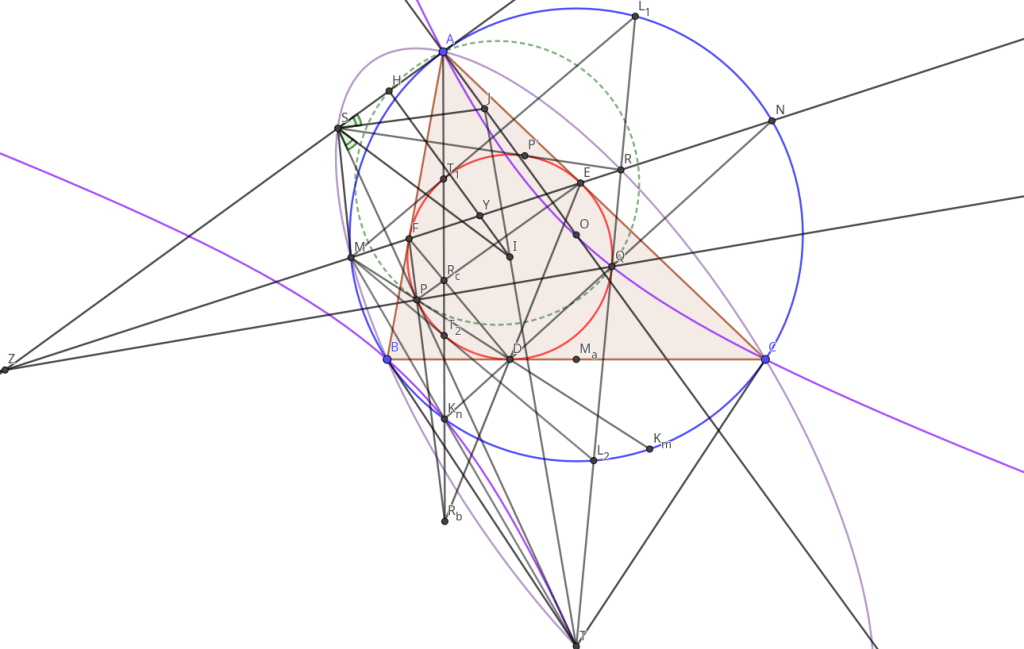
 and
and  are the tangency points from
  to the incircle
  and
and  show that points
  ,
,  and
and  all lie on the same line.
 and
and  show that points
  ,
,  and
and  are collinear. Thus, the line through
  and
and  implies that points
  and
and  are collinear.
 .
. and
and  be the tangents from
  .
.
 is harmonic, so points
  and
and  is the harmonic conjugate of
  .
. yields that
  lies on
  .
.
 it follows that
  lies on the polar of
  and
and  and projecting through
  is harmonic.
 and
and  are the polars of
  is tangent to
  and
and  lie on the tangent from
  , projecting through
  lies on the polar of
  – the intersection of the tangent to
  , with respect to the incircle.
 concur at
  , the second tangency point from
  .
. is harmonic which also implies that points
  and
and  and
and  implies that points
  ,
,  and
and  are collinear and thus points
  and
and  also lie on this conic.
 and
and  are also conconic which is easy to confirm via Pascal’s Theorem.
 is the polar of
  which implies that quadrilateral
  is cyclic. Further,
  which implies that quadrilateral
  is also cyclic.
 is the isogonal conjugate of
  since
since  is clearly the internal
  bisector. This wraps up
  to
to  .
.
 and
and  cyclic. Hence, by Reim’s it also follows that
  . Moreover, this means
  as well. Also, it is clear that
  is cyclic due to the right angles.
 be the feet of the altitudes from
  and
and  are both cyclic.
 . Similarly,
  which implies that
  .
. so it follows that
  .
. must lie on the line through
  . Thus,
  .
. . This swaps
  with
with  and thus
  . Moreover, since
  this circle is tangent to
  which proves
  of
of  then implies that
  lies on the line through
  perpendicular to
  and
and  is cyclic it is also clear that points
  and
and  are equidistant from
  is a kite, and hence harmonic.
 implies that
  lies on the line through
  and
and  through
  and a further projection through
  and
and  and
and  to the sides
  and
and  must be the reflections of
  and
and  as well, so by Reim’s theorem
  must also be cyclic.
 it follows that the orthocenter of
  is the intersection of lines
  and the line through
  lies on
  it follows that
  lies on the line through
  is parallel to
  consecutive integers of which exactly
  satisfy a desired property
  .
.  is said to be crazy if and only if there exists positive integers
  for which
  . Show that there exists a set of 2014 consecutive natural numbers of which exactly 2012 are crazy.
 which records the number of crazy integers in the set
  .
.  . Furthermore, for all positive integers
  we have
  which is clearly crazy. Hence,
  .
. (think about why this is true),
  there must have been some point where
  was exactly equal to 2012.
 .
.  , of successful free throws he has made in his first
  .
. increase by one, causing
  moves from below to above 80% of
  is the ratio of two consecutive integers. For example, if 80% were replaced by 60% the argument would break since the corresponding function would then be
  which does not satisfy discrete continuity when either increasing nor decreasing, so it is possible for
  points in the plane, no three collinear, and the
  triangles with vertices in
  of these triangles.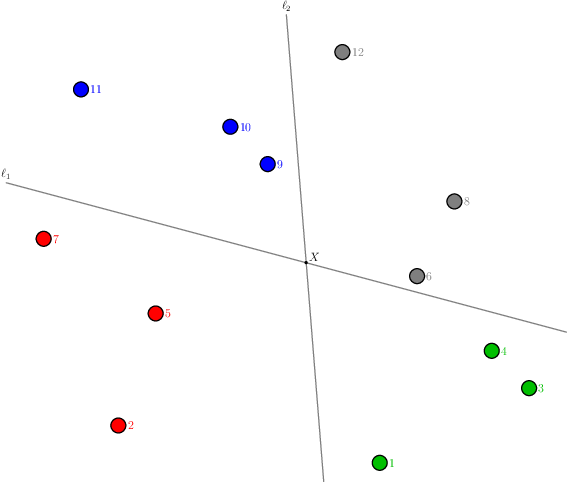

 in the plane, there exists a line
  which is parallel to
  points on each side of it. This is clear since starting with a line parallel to
  points on each side of the line and end with
  implying that by the discrete intermediate value theorem, there exists some intermediate moment where the line split the set of points into two equal groups.
 split the plane into four regions. We begin with the regions having exactly
  points each and end with them having
  points each implying that at some moment we must have had exactly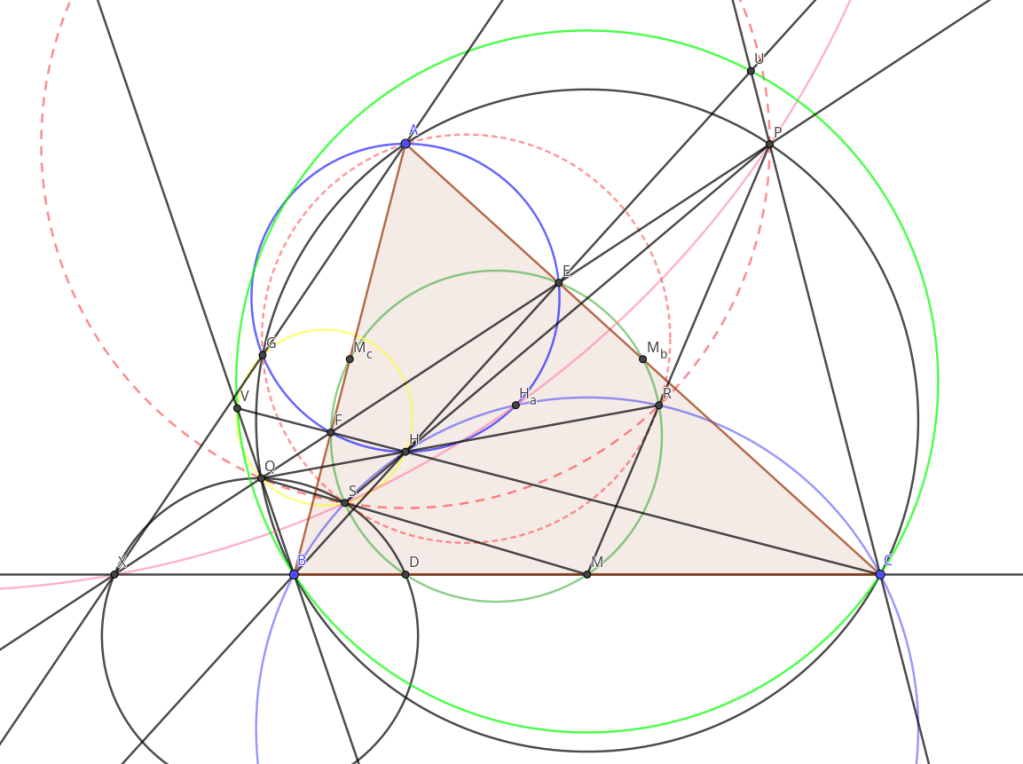
 followed by a reflection across point
  and
and  . Hence,
  and
and  and
and  which indicates that
  , and similarly
  is cyclic.
 is cyclic, this also implies that
  passes through
  . This swaps
  and
and  so quadrilateral
  is cyclic with center
  , the quadrilateral
  is a kite and is thus harmonic. Projecting through
  which is sufficient to conclude that the polar of
  which solves this
  . This swaps
  ). Hence, this swaps points
  and
and  and
and  and similarly quadrilateral
  are cyclic.
 so quadrilaterals
  and
and  are both cyclic.
 which implies that quadrilaterals
  and
and  are both cyclic.
 which implies that quadrilaterals
  and
and  are also both cyclic.
 we have that
  is self polar with respect to
  .
. and
and  are cyclic.
 and
and  are cyclic.
 and
and  lies on
  and similarly
  lies on
  , which solves
  it follows that
  and hence
  . An alternate proof is to apply Pascal’s Theorem on concyclic hexagon
  .
. is cyclic.
 lies on the line through
  .
.
 bisector proving
  stones in total. In each move, the topmost stone in each pile is picked and a new pile is formed with these stones. The goal is to show that eventually we end up with
  stones in them respectively.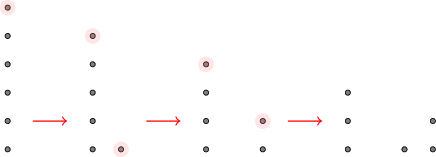
 which passes through the lattice point to the immediate left of the leftmost point in the bottom row. Reflect the bottom row across
  .
. 
 ,
,  and
and  .
.  always stays there since the reflection sends it to
  and the displacement vector sends it back to where it started. In fact, this is precisely the way to motivate this representation – it ‘anchors the base point’, so to speak.
 . Looking at the above picture, we can make two key observations.
 to
to  which are in the same diagonal (once again assuming it does not fall down).
 which is not occupied (called a hole, say
  ), and at least one stone outside the filled triangle and diagonal
  ) lies on diagonal
  (since stones must fall down if they are able to). We claim that this stone eventually fills the unoccupied point in diagonal
  eventually (within
  moves) the hole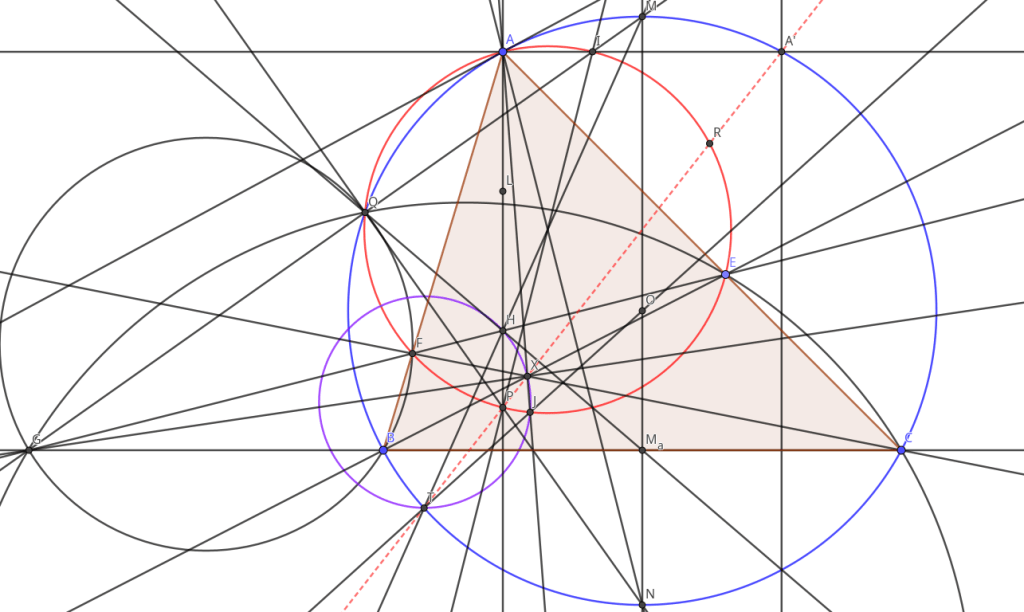
 and points
  and
and  passes through the
  which has been questioned previously, most prominently in
  .
. and
and  are both cyclic.
 angle bisector. Let
  and
and  be the intersections of
  with lines
  and
and  respectively.
 and
and  are both cyclic, and in particular tangent to line
  and
and  which is the key result in
  and
and  as well as lines
  and
and  concur on
  and
and  .
. and
and  .
. with
with  lies on the perpendicular from
  is harmonic.
 . Thus, this claim implies that
  and
and  , we can obtain several claims via pure angle chasing.
 ,
,  ,
,  ,
,  and (pentagon)
  are all concyclic.
 can also be observed to be the internal
  bisector.
 passes through several key points. For starters, an easy angle chase shows that it passes through the
  and
and  concur on this line as well which solves the following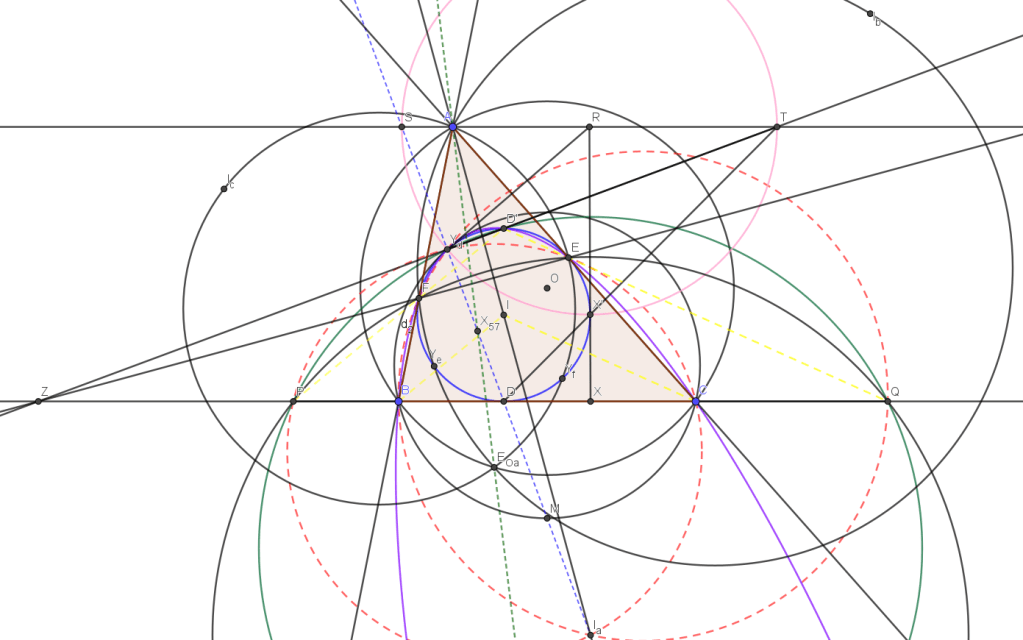
 and
and  pass through the reflections
  is the radical axis of these two circles.
 lies on
  antipode in
  , which is the statement of
  pass through the
  is cyclic from which Radical Center Theorem on circles
  and
and  we have that lines
  and
and  and
and  is tangent to
  at
at  and
and  concur at
  defined as the tangency point of
  (the circle through
  to
to  where
where  and
and  are the midpoints of segments
  and
and  , whose tangency point to the circumcircle is the Why Point as per
  ,
,  and
and  are also concurrent.
  is the reflection of
  and similarly, lines
  and
and  concur at the centroid of
  ,
,  and
and  also concur at this homothety center
  to the picture, which we know is the symmedian point of
  ,
,  shows that the second tangent to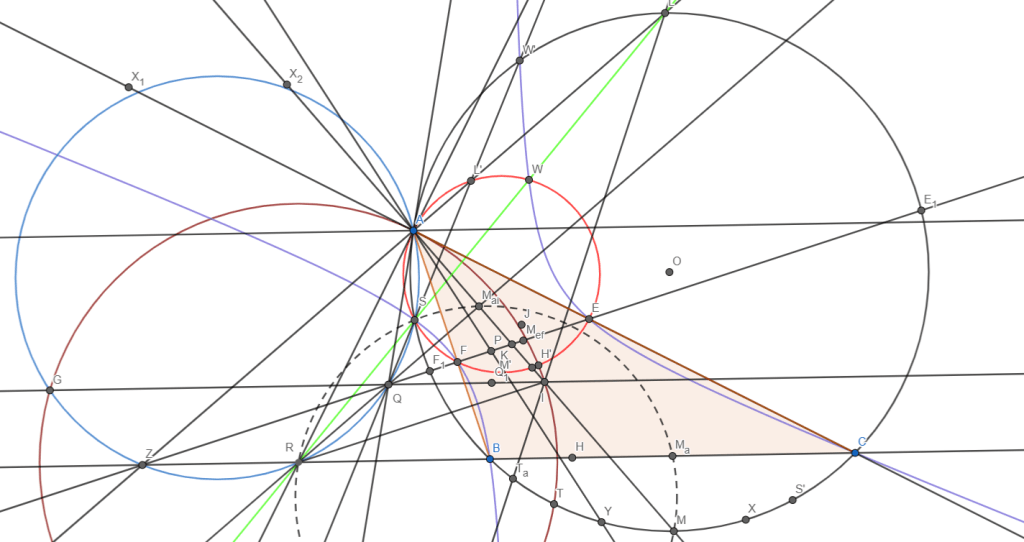
 ,
,  and
and  are cyclic. Also a straightforward angle chase then shows that
  and the tangent to
  the intersection of the tangent to
  at
at  . Since
  is harmonic (project through I!) it follows that
  . This point plays a great vouge in mixtillinear incircle problems. Particularly,
 are parallel. This is essentially
  while points
  and
and  is the perpendicular bisector of segment
  , which implies
  and circle
  is the second tangent from
  and
and  are parallel. This property generalizes when
  allows us to show that points
  also lies on this conic.
 to observe that points
  turn out to lie on the same conic.
  with circle
  and
and  are cyclic. Utilizing this a simple angle chase leads to the claim that points
  intersects
  ,
,  ,
,  and
and  lie on the same circle since
  and
and  and
and  is harmonic it turns out that ray
  hits
hits  .
.  are concyclic.
 and
and  are isogonal, points
  bisector lies on the circle
  which is the pith of
